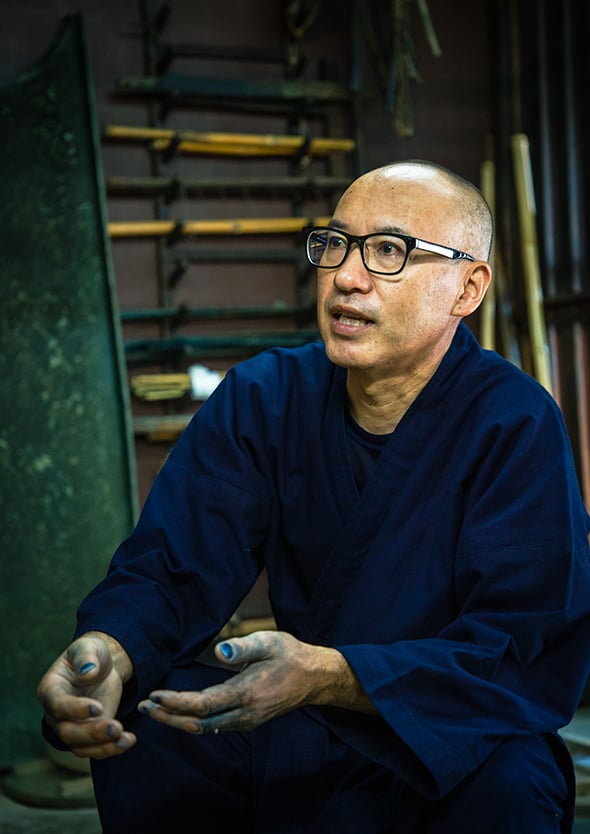
The 400-Year Watanabe Dyeing Legacy
-First, could you please tell us a little about the history of Watanabe Dyehouse?
Sure. This town sprouted up around Gujo Hachiman Castle in the late 16th century, which is when my forebears began their work as dyers here. The area was a crucial transportation hub with everything a dyer needs to operate in abundance – plus high demand from the castle samurai and townspeople for clothing, furoshiki wrapping cloths and banners and curtains for the local temples and shrines. The indigo dyeing industry peaked here in the Edo period (1603–1868), when there were 17 koya dye houses in Gujo Hachiman alone.

Gujo Hachiman Castle is said to be built on the very same site where samurai Morikazu Endo first set up his military camp in 1559
As the Meiji (1868–1912) and Showa (1926–1989) eras progressed, chemical dyes and machine printing replaced traditional methods. Dye houses gradually faded from existence, and by the 1960s we were the sole survivor in Gujo Hachiman.
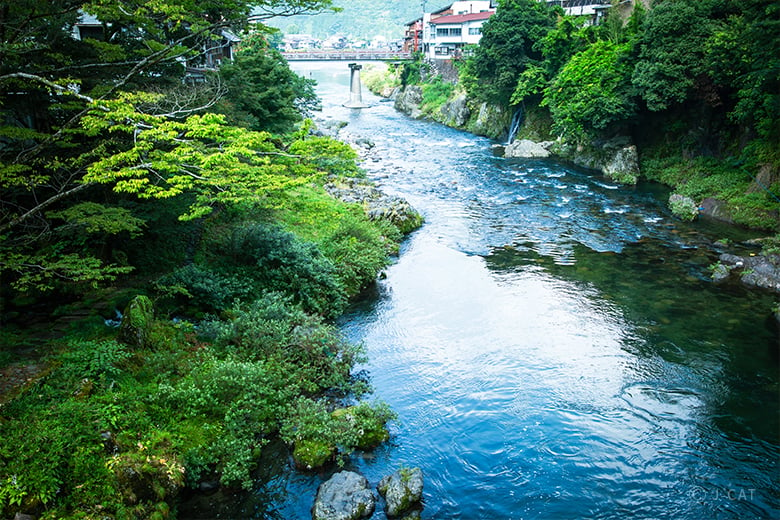
Today as in ages past, local people live in harmony with the rivers
My father, Shokichi Watanabe – who also worked under the name Yasuhei Hishiya – was our business’s 14th proprietor and was recognized for his contributions to traditional conservation of the “Gujo Honzome” dyeing tradition. In 1977, he was listed by Gifu Prefecture as a Holder of Important Intangible Cultural Property. That’s how rare what used to be a staple industry of the town has become.
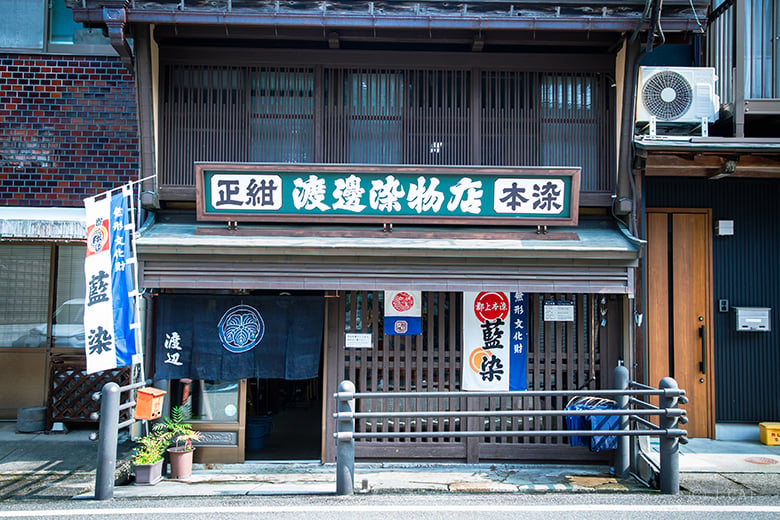
Watanabe Dyehouse is located in the heart of Gujo’s main tourist drag, a mere 10-minute drive from the castle
Sho Aizome: Indigo Craft Dyeing Tradition Preserved Unchanged Since Time Immemorial
-What defines sho aizome indigo dyeing?
Sho aizome begins with sukumo, a fermented paste made by drying indigo leaves and then soaking them for about 100 days. The product of this is mixed with aku, a lye solution made from plant ash, and fermented inside large earthenware jars sunken into recessed pits in the dirt floor.
Perhaps surprisingly, the completed dye itself is a murky brown with no hint of the beautiful shades of indigo blue it imparts. These colors only emerge after fabric is dipped into the liquid and exposed to air. Oxidation is the final key, and you can watch the brown fabric change to green and then blue right before your eyes as the chemical reaction takes place. When a cloth has been satisfactorily dyed, we rinse it in our washing canal right outside our shop to further draw out the brilliant indigo hues through the oxygen in the water.
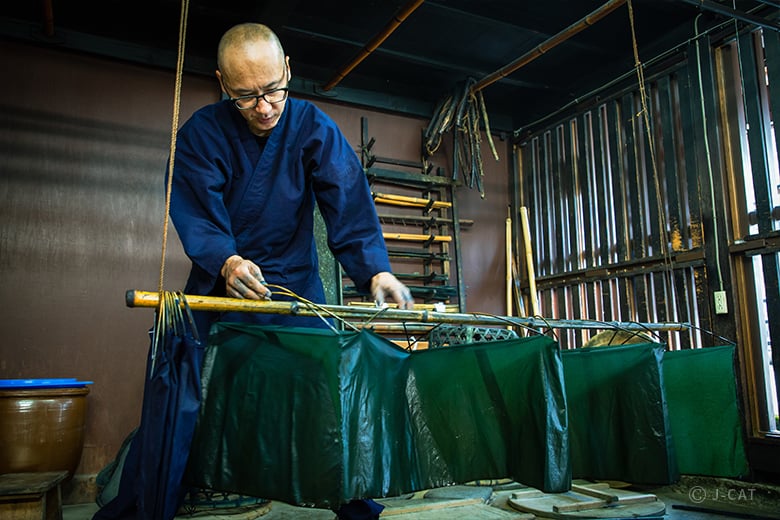
The alternating dip-and-airing process is repeated to achieve the desired hue – sometimes more than a dozen times
The entirely natural dye bath culture behaves just like you’d expect a living organism to behave – even needing a few days’ rest after a round of dyeing. For this reason, several sunken vats are kept on hand and rotated over a period of about two months, after which their coloring potency begins to wane and new vats must be prepared. Each vat is hand-stirred and inspected daily before any dyeing proceeds.
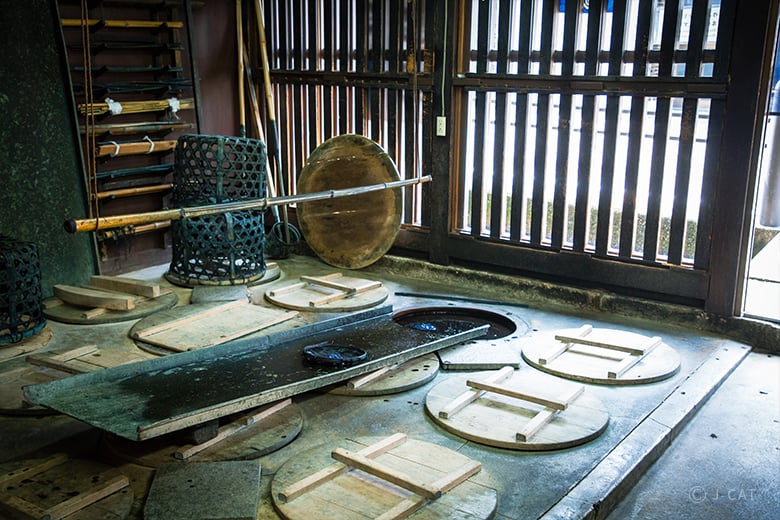
Dye vats sit roughly a meter under this earthen floor – listed by Gifu Prefecture as an Important Tangible Folk Cultural Property – to insulate them from temperature fluctuations
- What sets fabrics dyed with sho aizome apart?
Indigo dyeing techniques have a long and varied history, not just in Japan but around the world. There are a lot of different ways to do it. Beyond just the striking beauty of its colors, our sho aizome is also highly functional with natural insect-repelling, antimicrobial, and even flame-retardant properties. We believe that this combination of beauty and function is part of why these techniques have been prized and handed down over the generations.
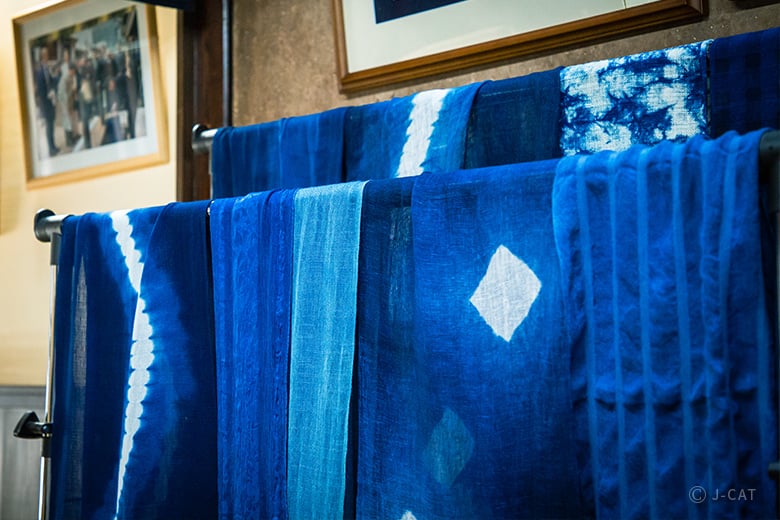
A veritable rainbow in blue adorns the walls of the shop, revealing the stunning variety of hues possible with indigo
The Currents and Flow of Gujo Hachiman Life
-It has been said that water has a special significance in Gujo Hachiman, hasn’t it?
There is no overstating that. Water is everything to us. We rinse our dyed fabrics in it. We make our solutions with it. The castle town’s system of canals, wells, and basins was developed right from the beginning for both firefighting and home use. Even now, stone or wooden basins and public wells are regular sights in the town – as are miniature canals built right outside homes and businesses.
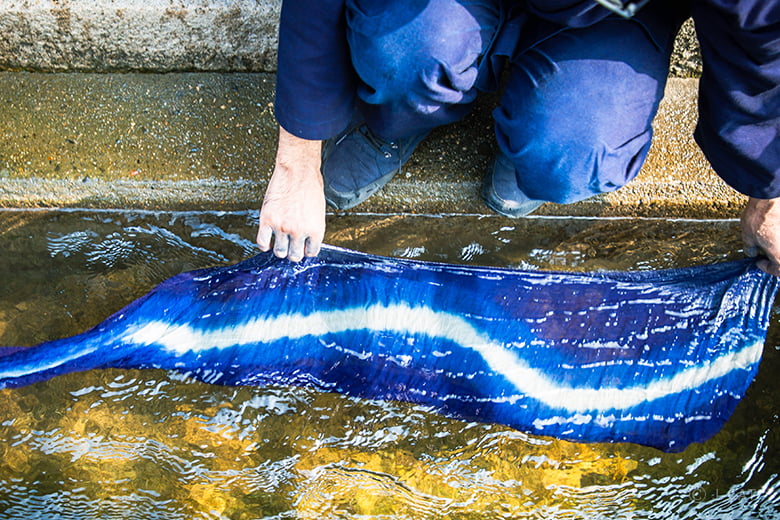
Dyed textiles being rinsed in the small canal outside the shop. Many homes and businesses in Gujo Hachiman are built with these small water channels just outside
These canals are an indispensable year-round cornerstone of life here: They are used to rinse vegetables, wash dishes, or chill fruit. Water is drawn from them and splashed onto the roadways to cool the air in summer. In winter, they form important drainage for snowmelt.
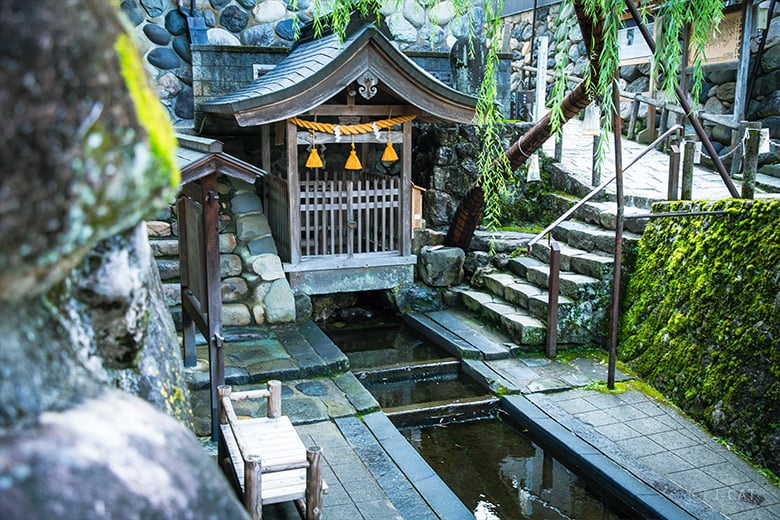
Sogisui is a beloved local spring listed among Japan’s “100 Famous Waters” and has been embraced as an icon of the town
Gujo Hachiman’s pure waterways have also made ayu sweetfish fishing popular. “Tomozuri” is one traditional method, using a live sweetfish as bait to capitalize on the competitive territorial social tendencies of these fish to draw others nearby. It is not uncommon to see ayu sweetfish stored alive in containers in the canals.
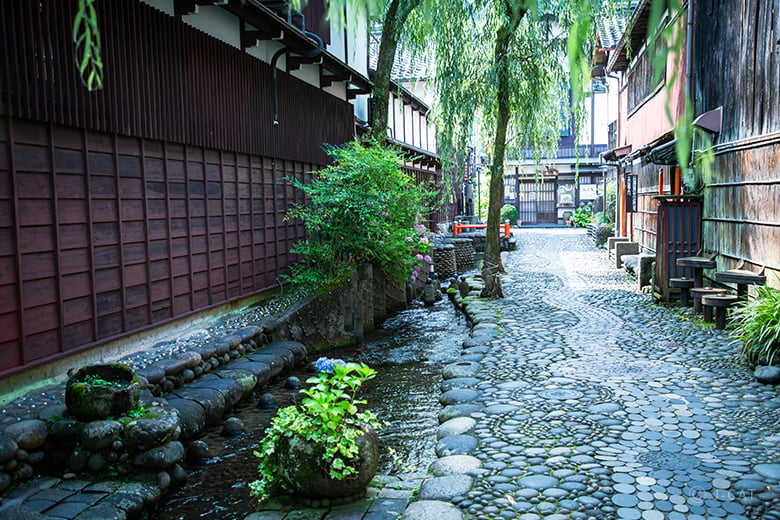
Yanaka Mizunokomichi is a charming walking path lined with river stones from the Nagara and Yoshida rivers
Seasonal Traditions: Gujo Odori and Kanzarashi
-Can you say a bit about the Gujo Odori dance tradition?
Well, the Gujo Odori is a traditional dance festival taking place over more than 30 nights from mid July through early September at venues all over the town including shrine courtyards, parking lots, and other public spaces across town. During the August Bon Festival, we dance all night for four consecutive nights – the peak of the festival that’s referred to as the Tetsuya Odori. Dyeing sometimes picks up during this time, as people want freshly-dyed yukata robes, geta sandal thongs, and tenugui hand towels in preparation for it.
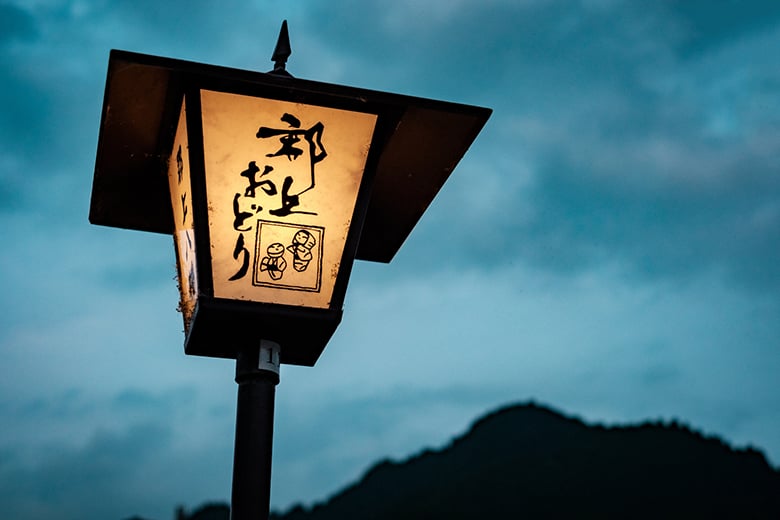
The town is lined with ornamental streetlights emblazoned with the words “Gujo Odori”
Everyone is welcome to join the dance, but only truly skilled dancers are recognized with an official certificate from the Gujo Odori Preservation Society. Certificates are offered for ten songs total, and some dancers collect these, brandishing them as badges of honor that determine their status in the festival.
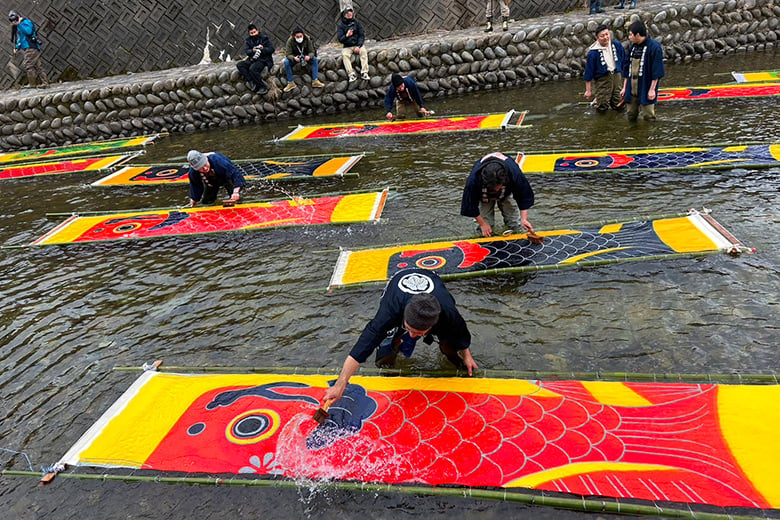
Kanzarashi in the Kodara river to rinse freshly dyed koinobori – festive and colorful carp streamers flown during May in Japan to celebrate the birth of baby boys
-That’s really fascinating. We’ve also heard there is a winter event known as kanzarashi.
That’s right. Our main indigo dyeing season runs from spring to autumn, and in winter, we color traditional koinobori carp streamers using natural rice paste masking and pigments made with soybean extract, rinsing with town water in the end – another wholly natural craft process.
This is unique because freshly dyed carp streamers are usually washed with cold water from basin storage, but in January and February we carry out kanzarashi, where the streamers are washed in the frigid river during the absolute coldest time of the year. The water temperature gets as low as 3°C, but this plus its crystal purity tightens the fibers and enhances the vibrancy of the dyes for unparalleled beauty.
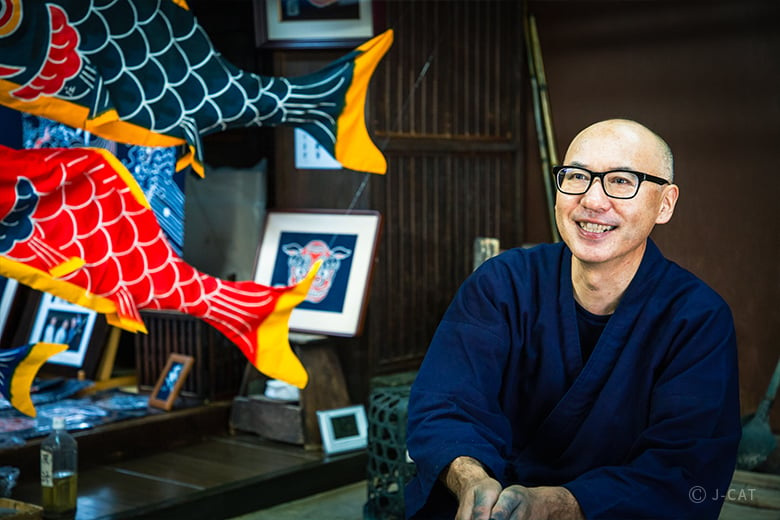
Watanabe’s dyed products have a deep connection to Gujo Hachiman’s traditional events
The Future of Watanabe Dyehouse and Gujo Hachiman’s Timeless Beauty
-Does a shop like yours, with centuries of history, still try new things?
Traditionally, we focused on dyeing noren curtains and furoshiki wrapping cloths. But we have branched into dyeing pouches, coasters, tote bags, and other more casual modern items. These days, fewer and fewer homes can really manage flying traditional oversized koinobori. As a result, we've begun producing compact ones that people can enjoy flying from balconies or hanging indoors.
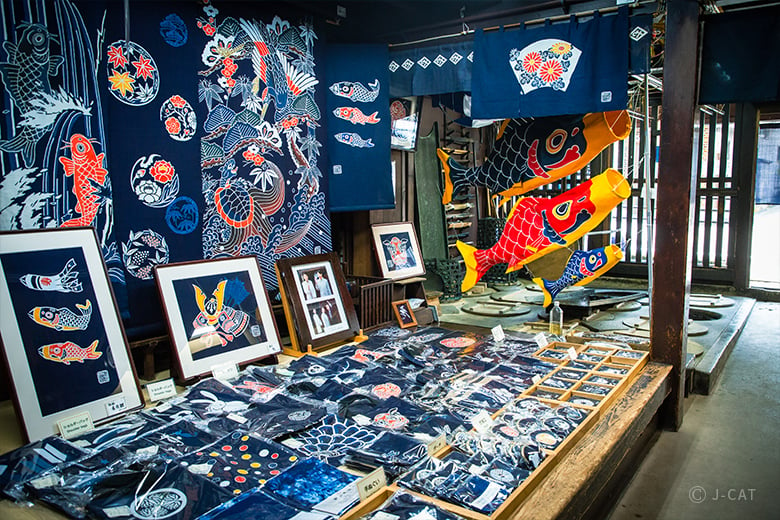
An assortment of indigo-dyed products lines the rear of the shop, popular with foreign visitors
-Could you give us a few final thoughts on the town itself?
Gujo Hachiman is easy to get to. We’re just over an hour’s drive from Nagoya, or from popular spots like Gero Hot Spring or Takayama.
The town also exudes a rich atmosphere and a beauty that changes with the seasons, revealing new faces throughout the year. Our culture is closely tied to nature and the rich water infrastructure that nurtures the town. The Nagara and its tributaries, the Yoshida and Kodara Rivers, have shaped the town and are still deeply enmeshed with life here.
It’s our hope to be good stewards of this precious heritage, cherishing and preserving it and the meticulous craft traditions it has made possible. We only have them at all because previous generations did the same for us.
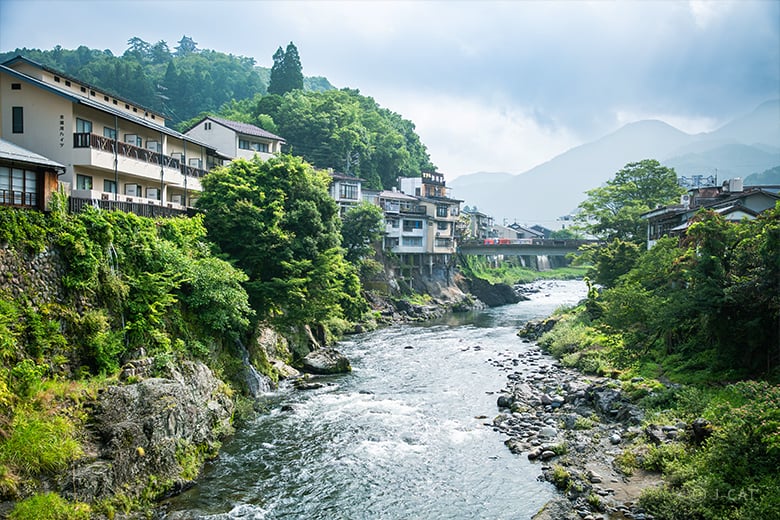
In summer, it is still common to see local children testing their courage by diving off the bridge over the Yoshida river that flows through the center of town
Watanabe Indigo Dyehouse
Founded in 1580 in the castle town of Gujo Hachiman, Watanabe Indigo Dyehouse carried a 4-century history spanning 15 generations of successive leadership, harnessing the town’s abundant water wealth to perform gorgeous indigo dyeing known as “sho aizome”. Its 14th generation proprietor, Yasuhei Hishiya (Shokichi Watanabe) was honored by Gifu Prefecture in 1977 for his contributions to revitalizing and repopularizing Gujo Honzome dye methods by being declared an Important Prefectural Intangible Cultural Property. His successor, Kazuyoshi Watanabe continues to work on preserving and passing down this precious heritage.