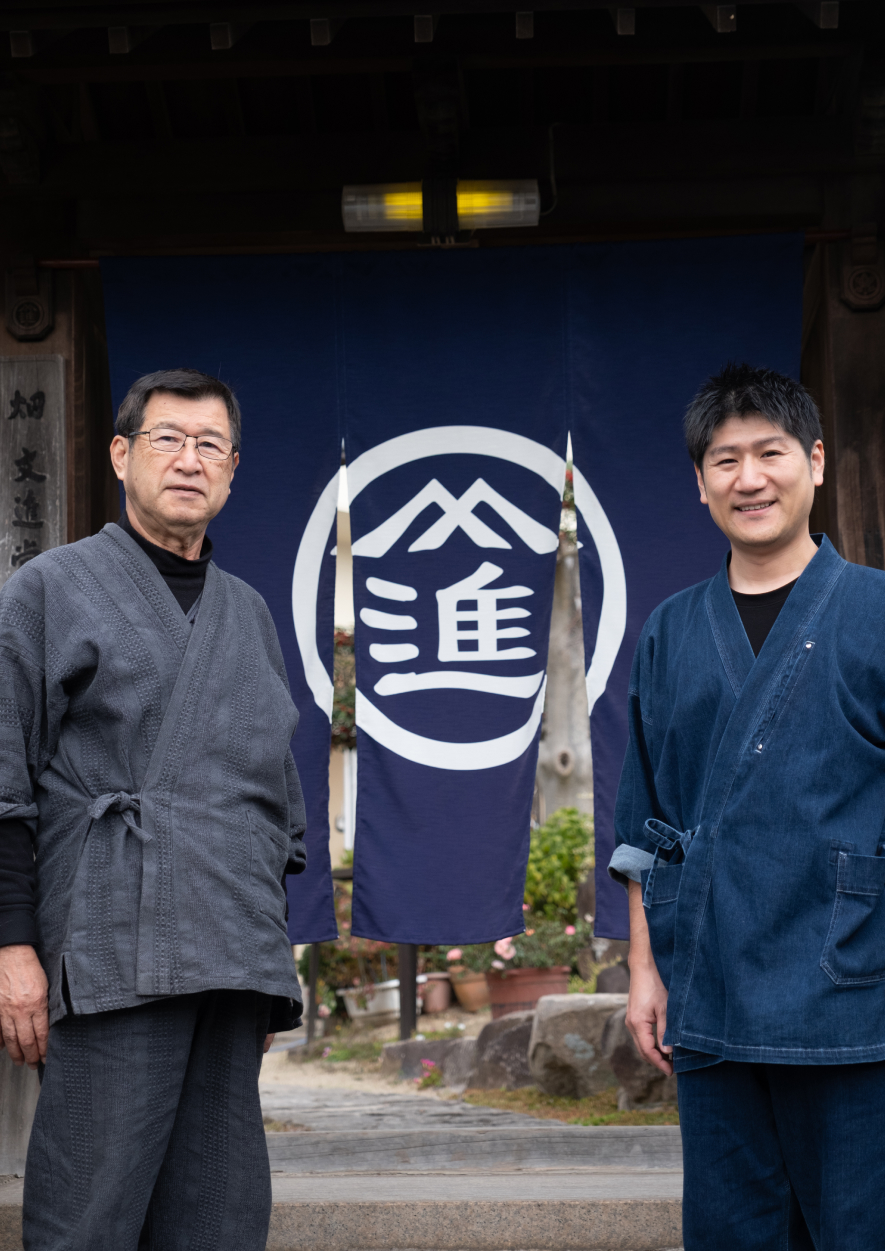
Kawajiri Brushes: Supporting Calligraphy Culture for Centuries
To this day, Hata Bunshindou’s Kawajiri brushes are made entirely by hand, with traditional Japanese brush-making techniques that have been passed down since the mid-19th century.
Surrounded by mountains, the town of Kawajiri in Kure City is home to Mt. Noro, which is associated with the renowned Buddhist monk and calligraphy master Kobo Daishi, also known as Kukai. It is also said that the townspeople of Kawajiri began making brushes as a way to keep themselves occupied during the off-season for farming. Kawajiri’s geography, which made crop-growing difficult, and its connection to calligraphy culture, made it possible for brush-making to flourish in the area.
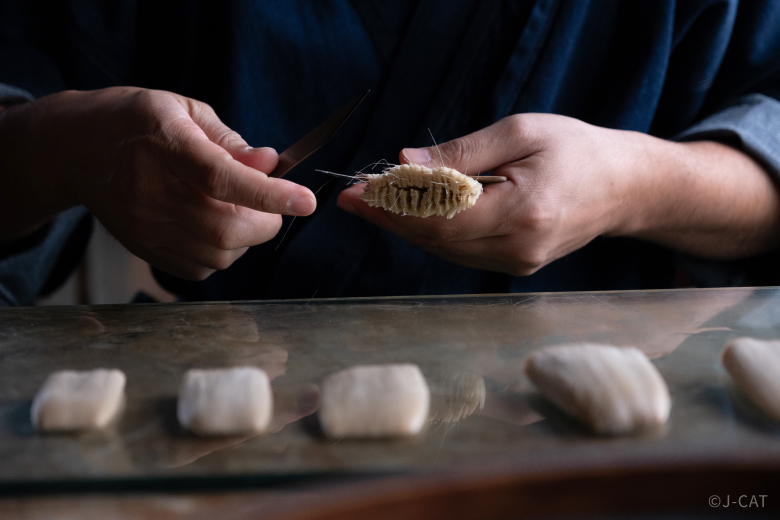
Hata Bunshindou’s Kawajiri brushes, which are individually handcrafted by artisans, have long supported calligraphy culture
As time passed, brushes became more than everyday stationery tools; they began gaining significance as artistic tools for calligraphy and painting. However, even during challenging times marked by decreasing demand, Yoshiyuki remained steadfast to his commitment to preserving tradition. Explaining his unwavering decision to protect his family’s workshop, he says, “Calligraphy culture can only survive when you have all three tools: brushes, ink, and inkstones. We must not let any of these die out.”
Yoshiyuki Hata: A Pioneer in High-Quality Wool Brushes
Familiar with brush-making since childhood, third-generation head Yoshiyuki Hata began assisting in his father’s work at the tender age of eight. “The workshop was my playground,” he recounts with a smile.
Hata Bunshindou is known for its one-stop production process. Each artisan is responsible for handcrafting a Kawajiri brush from start to finish, instead of dividing the different steps of the process among a team. Thus, creating a single brush requires considerable experience, awareness, and discernment. The brush-making knowledge that Yoshiyuki began accumulating at a young age served as the foundation for his future role as the head of Hata Bunshindou.
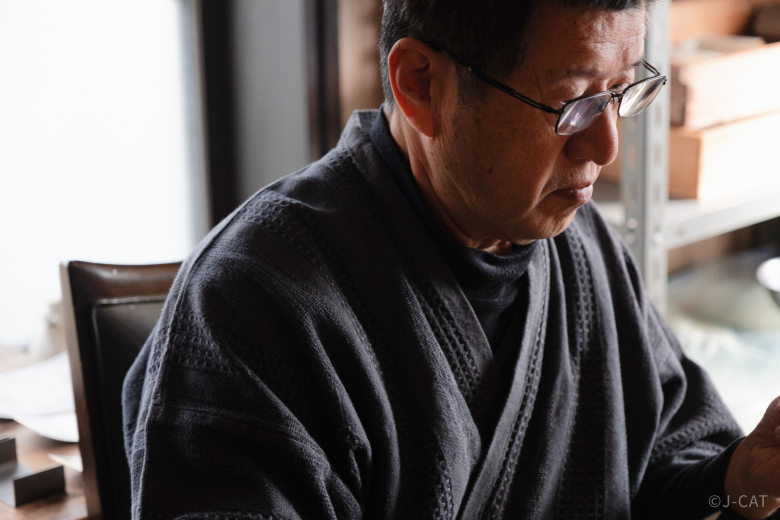
Yoshiyuki says, “My goal was to make the best brushes in all of Japan.”
At the age of 18, Yoshiyuki joined the family business full-time, where he continued refining his skills with the future goal of surpassing his predecessor. This challenge led him to innovate in the field of wool brushes. Generally made with goat hair, wool brushes are characterized by their softness. Though they can be difficult to make, for many calligraphers, they are the ideal brushes. Aiming to come up with his own wool brush-making techniques, Yoshiyuki traveled to China in search of premium wool and purchased large quantities of a rare, high-quality wool found along the Yangtze River: chest hairs from male goats.
Yoshiyuki recalls an order with a wait time of as long as 20 years, placed by a 80-year-old calligrapher who was drawn to the high quality of his brushes
According to Yoshiyuki, this investment was, in terms of cost, comparable to building a new house. However, this risk paid off, as it drastically improved the quality of Hata Bunshindou’s brushes and solidified calligraphers and fellow artisans’ trust in the workshop. These superior-quality wool brushes created with Yoshiyuki’s innovative techniques gained popularity nationwide, cementing Hata Bunshindou’s reputation as a maker of artisan-quality brushes.
Koso Hata: A Different Perspective to Succession
For Koso Hata, fourth-generation head of Hata Bunshindou, the family workshop also became a part of his life from a young age. As a child watching his father, he already felt as early as back then that his father’s work was something special.
A turning point came during Koso’s university years. Yoshiyuki suffered a serious accident that led to a damaging spinal injury, prompting him to consider shutting down the workshop at one point. Fortunately, however, he made a miraculous recovery. Recalling this, Koso says, “It felt like a powerful force was pushing him to continue making brushes.”
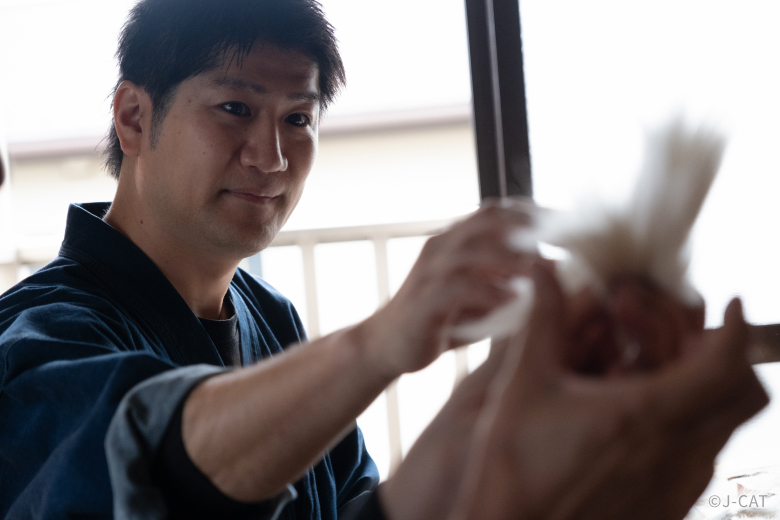
Even at a young age, Koso was already amazed by the “incredible things” that his father was doing
Joining the family business at age 22, Koso thought, “I’ve finally made it this far.” His experiences working with high-quality brush hairs in childhood equipped him with the ability to assess a brush’s quality simply by listening to the sounds being made during production. “Looking back, I’m truly grateful for the things I learned naturally from a young age,” he says.
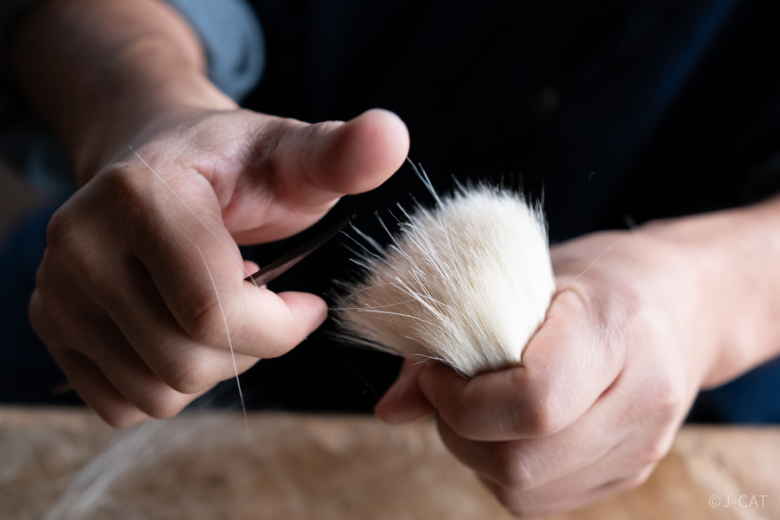
Accumulating knowledge and training in childhood, even without realizing it, paid off for Koso as he became involved in creating high-quality brushes
In contrast to Yoshiyuki, who comes off as the quiet artisan type, Koso is more proactive and outspoken. Expressing an openness to expanding to new markets, Koso says, “Brushes are not the kind of products that are strongly tied to their place of origin. I want to promote the value of our brushes as Hata Bunshindou, instead of relying on the ‘Kawajiri’ area name.”
Supporting his son while respecting differences in perspective, Yoshiyuki simply says, “He should work with the sensibilities of a fourth-generation head.” His words perfectly illustrate a relationship that is common within artisan families in Japan: they are not only parent and child, but also a master and disciple, or mentor and apprentice.
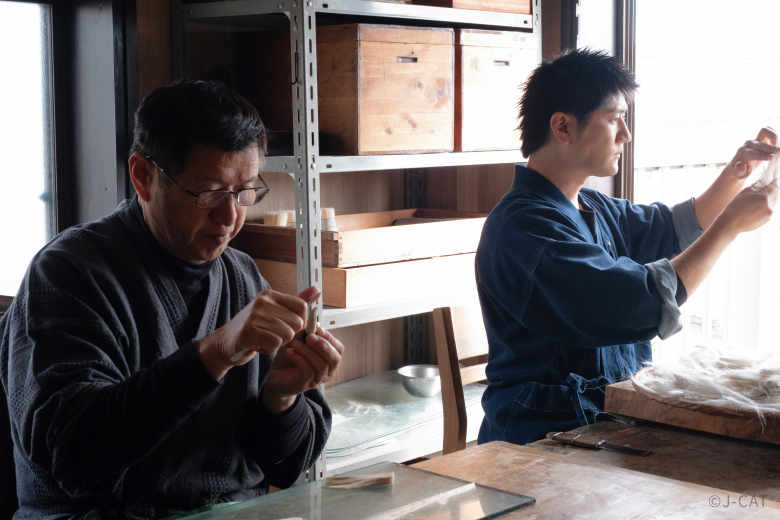
As brush-making requires the use of all five senses, many aspects to it cannot be expressed in words
A Cycle of Entrusting and Inheriting Tradition
Regarding the future of Hata Bunshindou, Koso says, “Since it is difficult to find other applications for brush-making techniques, instead of expanding our lineup just for the sake of it, I would like to emphasize the mindset of ‘onko chishin’—learning from the past while looking to the future. I want to find new avenues within tradition.”
Despite these words, Hata Bunshindou has further gained international acclaim by branching out to new fields such as makeup brushes. The tips of Hata Bunshindou’s makeup brushes have been well-received for their soft, smooth application that can seemingly cover up rough spots — a unique feature of handmade brushes. This made Koso realize that Hata Bunshindou’s techniques are also recognized overseas.
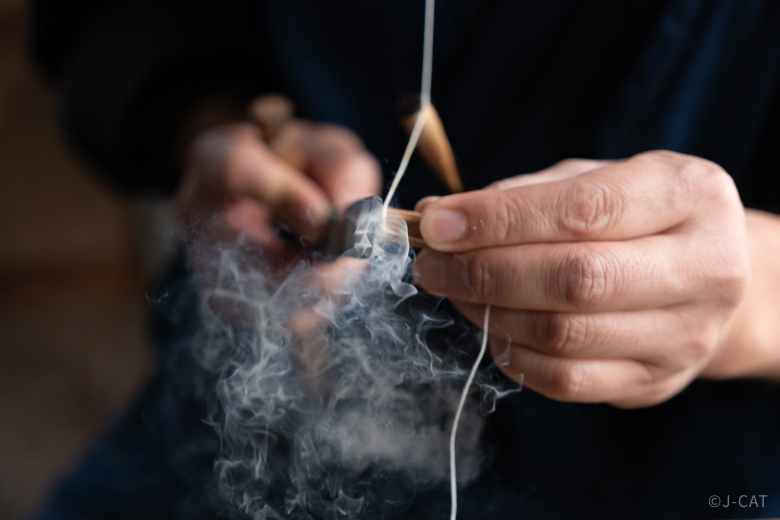
Crafted with genuine artisanal spirit, Hata Bunshindou’s one-of-a-kind brushes are highly acclaimed worldwide
Relaying his hopes for the future, Yoshiyuki says, “I would like my son to make full use of his sensibilities as the fourth-generation head, and learn from and make up for my shortcomings as his predecessor. I want to use the rest of my life as a craftsman to give back to everyone who has supported me to this day.” Both father and son’s words are filled with determination to pass on traditional crafts to the future.
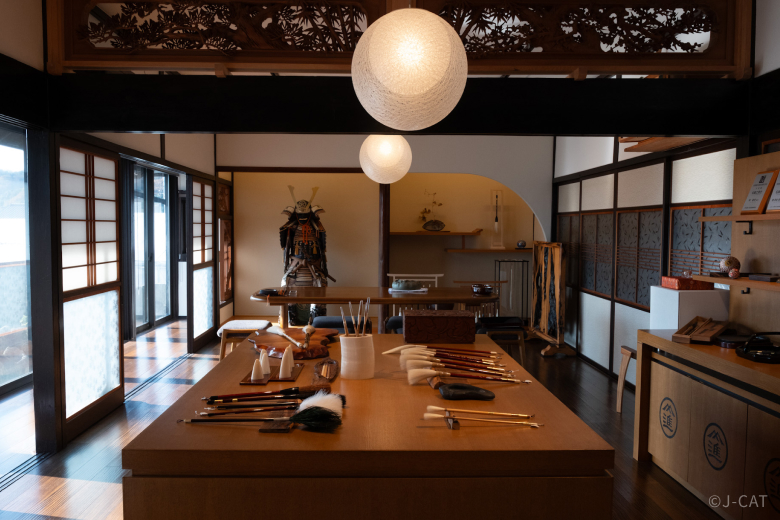
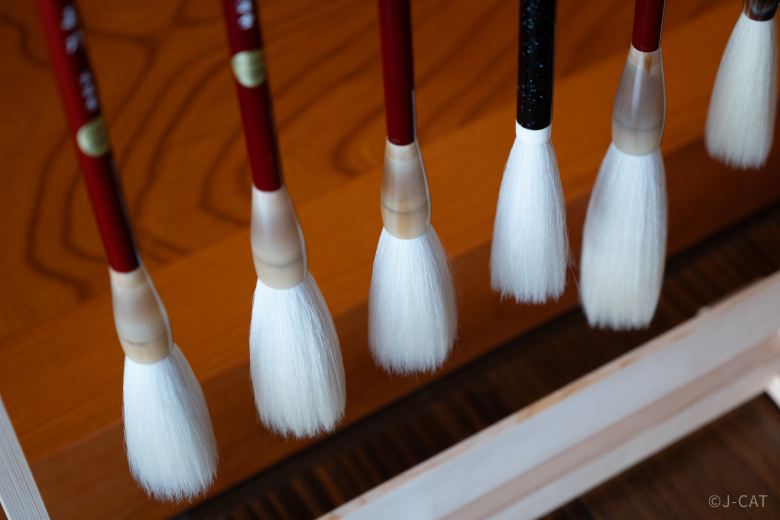
Hata Bunshindou’s showroom is lined with an extensive array of brushes
Brush-making is more than just making a tool. It is also about building a culture of carefully sorting and selecting materials, sharpening one’s senses right down to the fingertips, and resonating with the people who will use the product. Hata Bunshindou is a workshop that takes pride in its expertise accumulated over the years and, above all, a passion for artisanship — all of which Yoshiyuki and Koso Hata aim to pass on to the future through dedication and mutual respect.
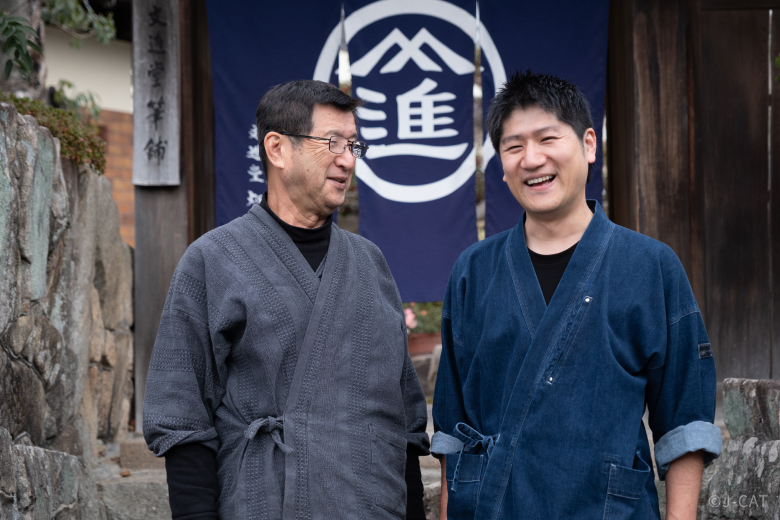
Yoshiyuki and Koso Hata continue passing on Hata Bunshindou’s brush-making techniques to the future
Wabunka offers a special plan in which you can experience the Hata family’s warmth and uncompromising artisanal spirit for yourself. In this plan that includes brush-making and basic calligraphy, you can see and feel for yourself the rare wool that Yoshiyuki went out of his way to purchase, experience the craftsmanship and attentive care behind each brush, understand why Kawajiri brushes are so highly valued, and take home a Hata Bunshindou brush.
Hata Bunshindou
Also known as Bunshindou Hataseihitsusho (Bunshindou Hata Brush-Making Factory), the long-standing Hata Bunshindou has crafted Kawajiri brushes since 1930. These high-quality brushes have been a traditional handicraft of the town of Kawajiri, now a part of Kure City in Hiroshima Prefecture, since the mid-19th century. At Hata Bunshindou’s well-known one-stop workshop, every step of the brush-making process is meticulously done by hand.
Third-generation head Yoshiyuki Hata, a recipient of the Minister of Economy, Trade and Industry Award, is a master artisan whose craftsmanship is highly trusted by calligraphers in Japan and overseas. In 1987, he presented a brush to the Prince and Princess Hitachi when they visited Hiroshima, and in 2019, he received the Order of the Sacred Treasure (Gold Rays with Rosette), a national distinction awarded to individuals who have contributed significantly to public service.
Currently, Yoshiyuki and fourth-generation head Koso Hata work closely together as they combine traditional techniques with contemporary perspectives and promote the appeal of Kawajiri brushes to the world.


