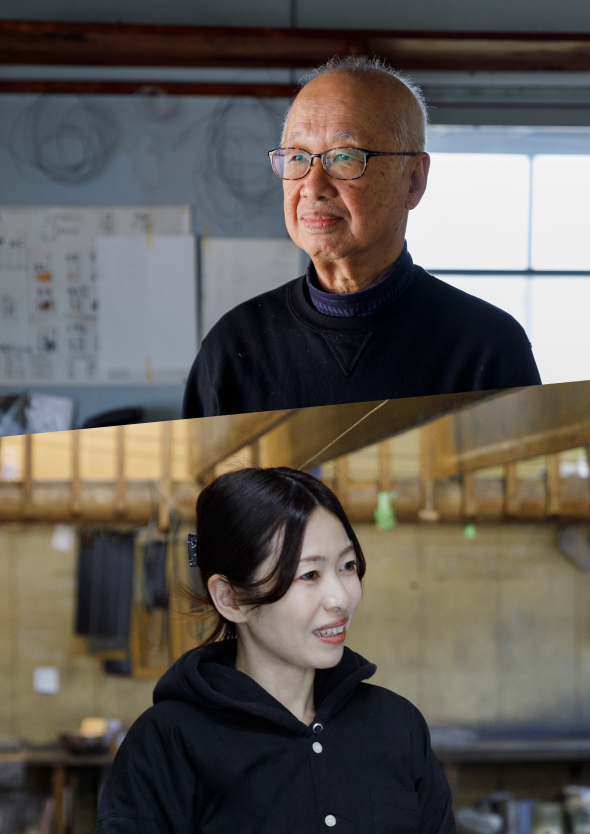
Ishizuka Senko: Creating New Possibilities While Preserving Traditional Techniques
A Japanese saying goes, “God is in the details,” and that may be true for the traditional Japanese pattern known as Edo komon. From a distance, this type of stencil dyeing may look plain, but a closer look will reveal a beautiful and intricate pattern in white against the base color.
Edo komon developed in the late 17th century, approximately the middle years of the Edo period (1603–1868). It became widespread when the shogunate's prohibition of displays of luxury prevented samurai and townspeople from wearing exquisitely detailed kimonos. Edo komon, which did not display beauty conspicuously but rather expressed it subtly, thus became popular among fashion enthusiasts of the time.

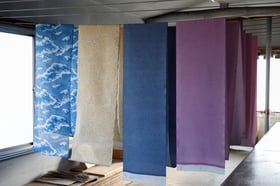
Each roll of Edo komon fabric from Ishizuka Senko is a testament to the artisans’ masterful techniques and Edo komon’s unique elegance
Today, along with the decrease in demand for kimonos, demand for Edo komon has also decreased. However, one studio continues to this day to weave history with the spirit of sublime artisanship: Ishizuka Senko. Founded in 1890 in Odawara in western Kanagawa Prefecture, the studio later moved to Hachioji in suburban Tokyo in 1897. Here, where beautiful and pristine streams — which are essential to dyeing — flow, Edo komon dyeing techniques have been passed down continuously.
Hachioji has long flourished as a town specializing in dyeing and weaving. During the Edo period (1603-1868), it was also known for sericulture and production of silk goods. Then, from the late Meiji era (around 1900), its streets were lined with dyeing and weaving factories, as Hachioji developed as a hub for the textile industry. When Ishizuka Senko relocated there, it was already a town full of skilled artisans, as there were many dyeing and weaving studios in the area.
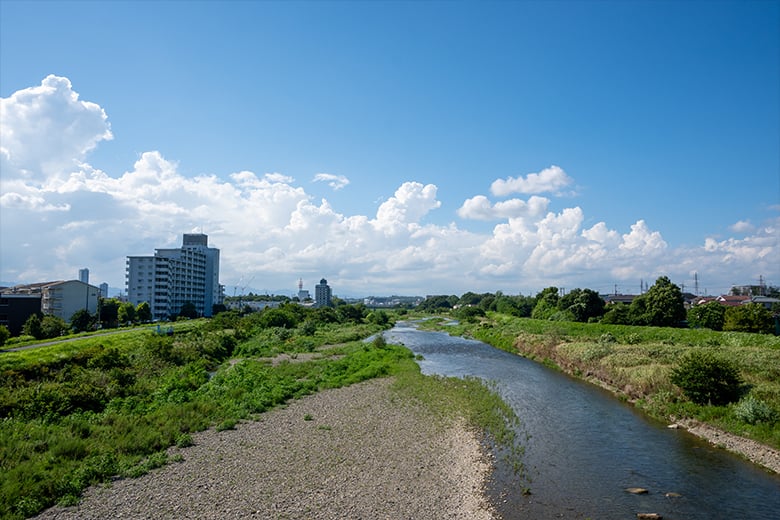
Hachioji's textile industry has long been supported by abundant spring waters from Asakawa and other rivers
The waters that flow through Hachioji, including the Asakawa River, play a significant role in dyeing. As rinsing steamed fabric with cold water to remove excess dye is a crucial step in the dyeing process, clear river water helps create the dainty finish of dyed fabrics. Such a resource-abundant environment has enabled Ishizuka Senko to continue upholding the traditional techniques of Edo komon dyeing.
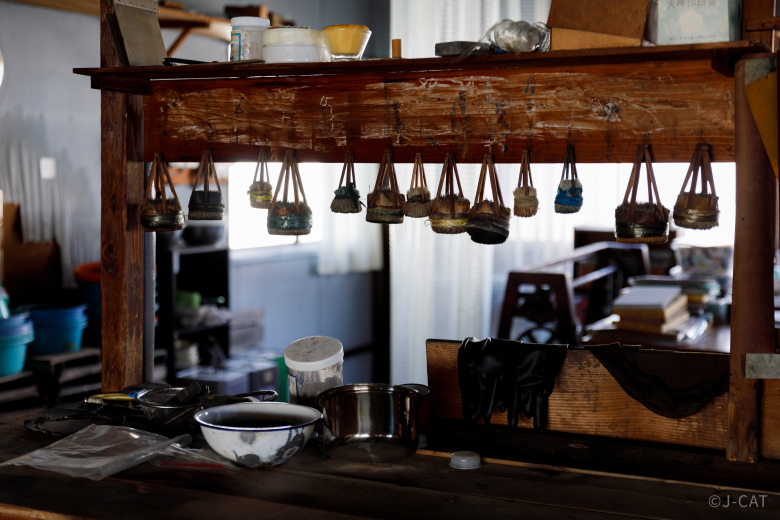
Tools used as part of traditional dyeing techniques are lined up at Ishizuka Senko’s studio, which has a history of over 100 years
The fourth-generation head of this studio is Yukio Ishizuka, a master artisan of Edo komon who remains active to this day. For his endeavors, the Japanese government has bestowed him the titles of “Master of Traditional Crafts” and “Tokyo Meister.” Following in his footsteps is his daughter Kumiko, the studio’s fifth-generation head. For a long time, the Ishizukas’ main clients were wholesalers whom they regularly did business with, as well as insiders in the kimono industry. However, in recent years they have opened up the world of Edo komon. They constantly tackle new challenges and possibilities for this traditional craft, such as launching an original brand that complements modern designs.
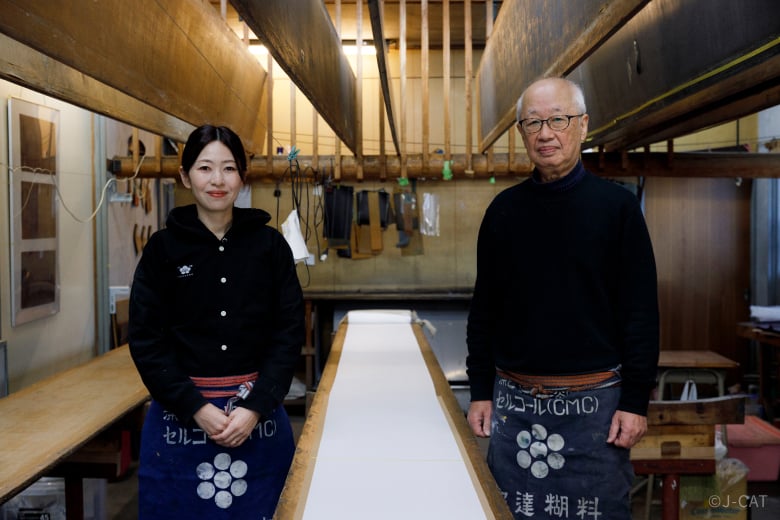
From left: Ishizuka Senko’s fifth-generation head Kumiko Ishizuka and the fourth-generation head Yukio Ishizuka
Yukio Ishizuka: Giving Life to Ishizuka Senko's Identity
As the fourth-generation head of a historic dyeing studio, Yukio Ishizuka spent many years watching artisans at work from morning to night. This is because, from Japan’s pre-war to post-war days, several artisans took up residence at Ishizuka Senko under the tutelage of the previous generation’s head. From an early age, Yukio loved to draw, so he says that his desire to work in an artistic and creative field such as dyeing came naturally. After gaining professional experience at a kimono wholesaler in Kyoto for about two years, he began to earnestly pursue the path of a dyeing artisan.
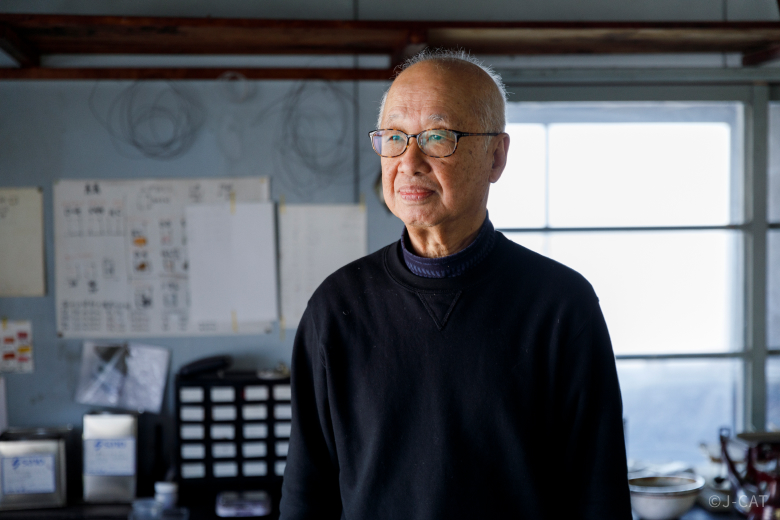
Behind Yukio Ishizuka’s calm demeanor lies the strength to weather the rough seas of the passage of time
In the past, Ishizuka Senko mainly focused on creating vividly dyed fabrics. However, due to changing fashion trends, switching to the simple-looking Edo komon became a matter of necessity. Many craftsmen found it difficult to switch from the dyeing methods that they had become familiar with over the years, and Yukio bore the full brunt of this. In addition to the standard dyeing process, Edo komon has an extra step called “ji-naoshi” — spotting and retouching uneven patterns, a highly advanced technique. Without a mentor to rely on, Yukio had to learn Edo komon dyeing techniques almost entirely on his own to keep the studio going.
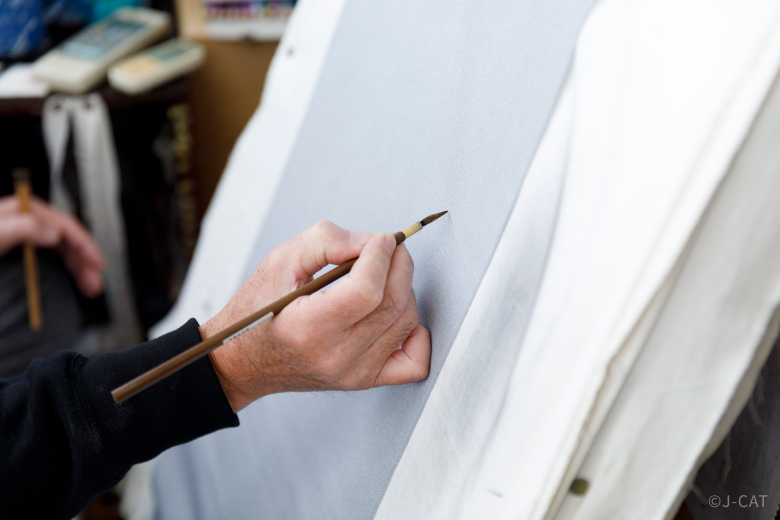
Yukio's hands have produced many masterpieces. Reflecting on his career, he says, “The only option was for me to just do it.”
According to Yukio, the difference in artisans’ skills can be clearly seen in the ji-naoshi process. “There is no defined end to ji-naoshi. Artisans individually decide how far they will go in retouching patterns. I always try to carry it out to an extent that satisfies me.” In his constant pursuit of the best, Yukio established Ishizuka Senko’s current identity as an Edo komon dyeing studio — an identity of particular significance.
However, things have not always been smooth-sailing. Yukio says, “There was a time when we were not able to sell any kimonos at all, and I had no choice but to let go of artisans whom I had been indebted to for many years. That was a difficult period.” It seems as if Yukio continues to carry the souls of his fellow artisans from back then on his shoulders as he goes about his work in the studio each day.
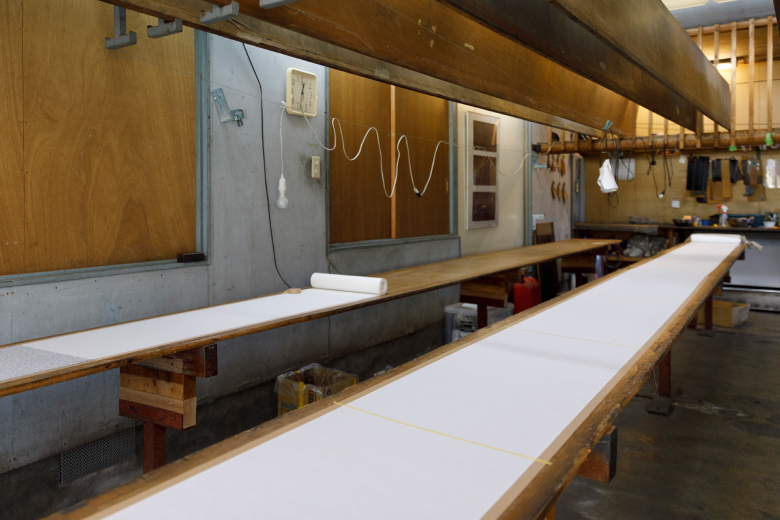
A refined workshop where you can feel the traces of successive generations of artisans
Kumiko Ishizuka: Shaping the Next Generation of Edo Komon
Yukio's second daughter Kumiko represents the fifth generation of Ishizuka Senko. As a young girl, the studio was her playground, and when asked about people she admired, she would answer, “Picasso, my father, and my grandfather.” Like Yukio, Kumiko, too, enjoys artistic and creative endeavors such as painting, so her desire to become a dyeing artisan developed gradually over time. After studying Japanese painting at an art university, she wanted to immediately take over the family business. However, at her father’s suggestion, she started working in the apparel industry. After gaining two years of work experience, she once again aspired to become a dyeing artisan’s apprentice.
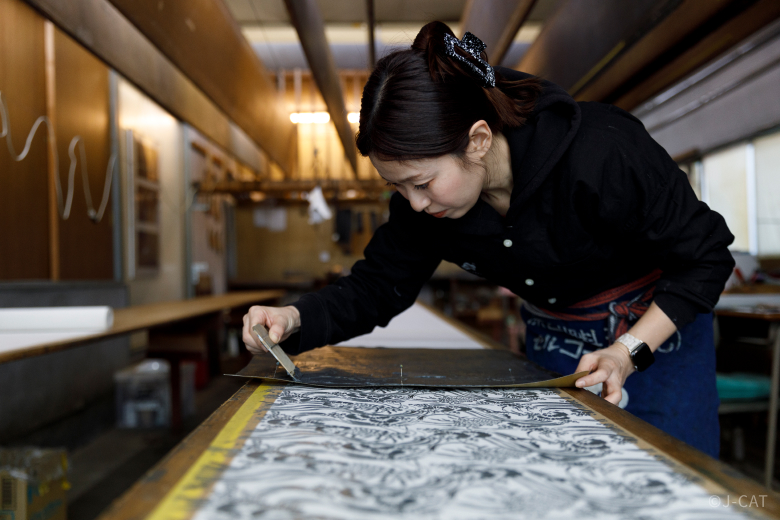
Kumiko is a mother to two children, who, perhaps someday, might come to admire their mother's way of life
“My family home and the studio are connected, so if no one were to take over the family business, the studio would disappear. It would be like losing my home. The thought made me sad, so I felt that I had to do something, or else I’d regret it,” Kumiko explains. Moved by Kumiko’s passion for the craft, Yukio relented, saying, “I suppose if it’s just a hobby…”
And so, Kumiko started out by balancing her apprenticeship at Ishizuka Senko with a part-time job. However, despite Yukio's concerns, her skills grew rapidly, and she eventually devoted herself fully to the studio. She became the fifth generation to take over the family business, and in 2024, she obtained a national license for traditional artisanship.
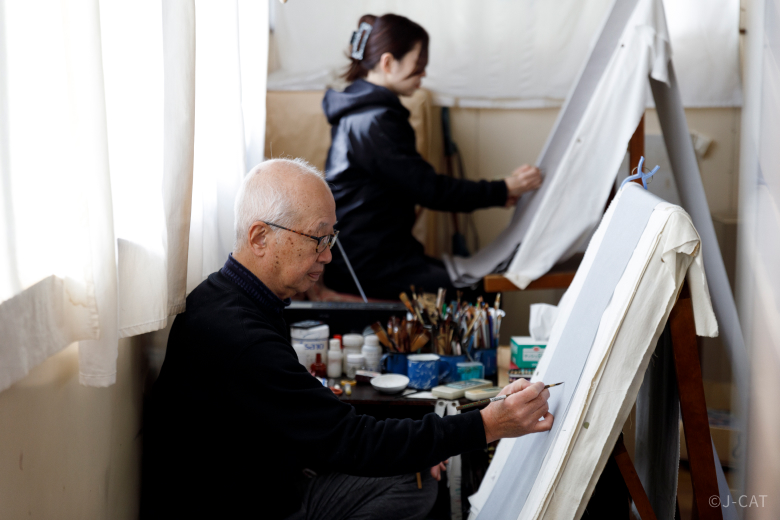
Yukio and the passionate Kumiko at work in the studio
Kumiko also came up with her own original brand, KATAUME, a launching pad for new ideas. She explores new possibilities by creating modern and refined Edo komon items such as the well-received bag Edo Komon KATAK"ATA, which she created in collaboration with a designer. Going well with both Japanese and Western clothing, the bag garnered attention for its pop-like colors and stylish design, earning it an award of excellence from the Tokyo Teshigoto Project.

Kumiko worked on Edo Komon KATAK"ATA, a stylish modern bag that incorporates Edo komon
Kumiko says, “My father would always give his harsh opinion, asking whether it would really sell. But I don't think there's any point in making something that I wouldn’t want to wear or use myself, so there were a lot of factors that I couldn't compromise on.” For example, she was particular about the bag’s chain-type handle, which is made of acrylic to give it an urban Tokyo feel. “My father had a confused look on his face until the end,” Kumiko laughs.
Iki: Making a Plain-Looking Object Anything But Plain
Though Japanese kimonos and accessories with traditional patterns are well-loved abroad, Edo komon has a different vibe from those already-popular designs. Yukio tells us that there is something that Edo komon conveys through its simple and seemingly plain appearance.
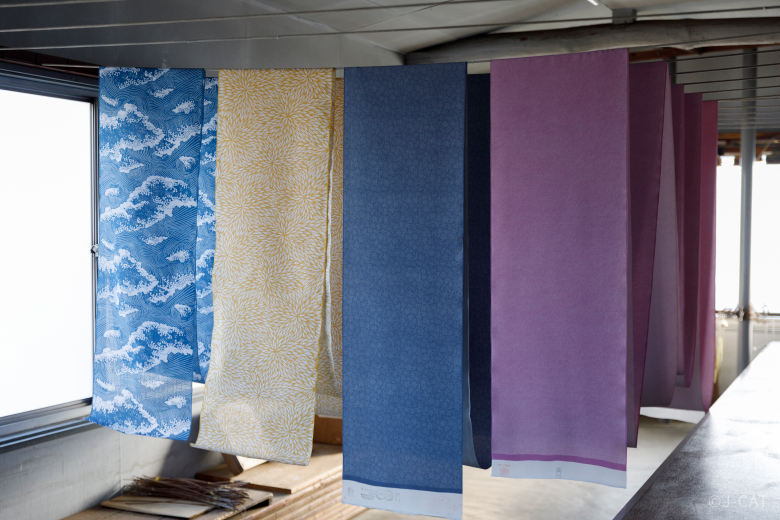
You can see the patterns on the fabrics once you get up close to them
He says, “Why go out of your way to add patterns to something that looks plain from a distance? Ordinary people would find this strange. However, this is precisely where the iki (chic) of Edo komon can be found. These fine designs can have over 900 patterns within a square area as tiny as three centimeters. Their beauty is not showy; it is so subtle that you will not be able to appreciate it unless you get up close. I hope that people abroad will be interested in this distinctive representation of Edo refinement.”
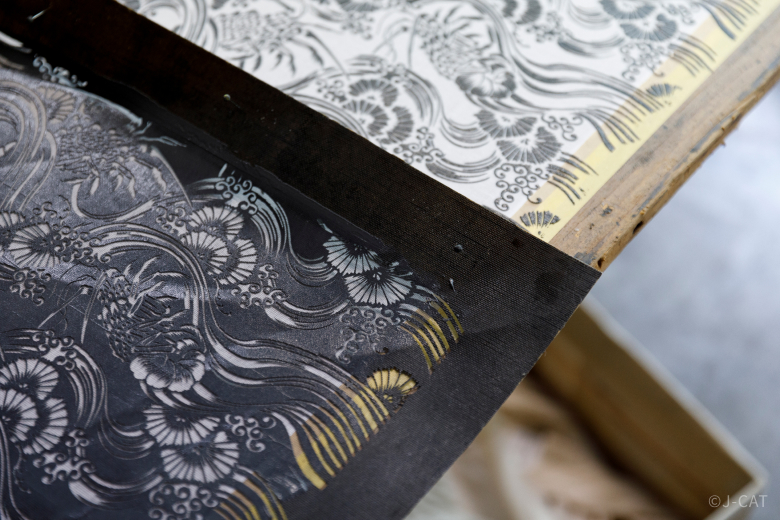
The intricate patterns of Ise katagami, paper stencils used for Edo komon dyeing, are created with a carving knife
Today, only a few studios in Japan still use Ise katagami stencils in dyeing kimonos, a technique from the Edo period. Kumiko explains, “The Edo komon technique of carefully dyeing each detailed pattern by hand is a culmination of Japan's distinctive aesthetic sensibilities and artisanship. I want to convey this mindset to the world through intricate designs and handiwork that evoke a sense of Japanese chic.”
A Comfortable Bond Between Father and Daughter
Not only are the Ishizukas family, but also, they are partners at work. On this, Kumiko says frankly, “Although my father sometimes scolds me at work, we get along well as a family. We go on trips abroad together, and he plays with his grandchildren. My view of my father has not changed since I was a child: I think that he is cool.” Meanwhile, Yukio, who is more reserved in comparison, says, "All I can say is that she is my daughter.” There is a comfortable air between the two, and anyone observing them will surely sense their deep affection for each other even without any words exchanged — a pleasant sight to behold.
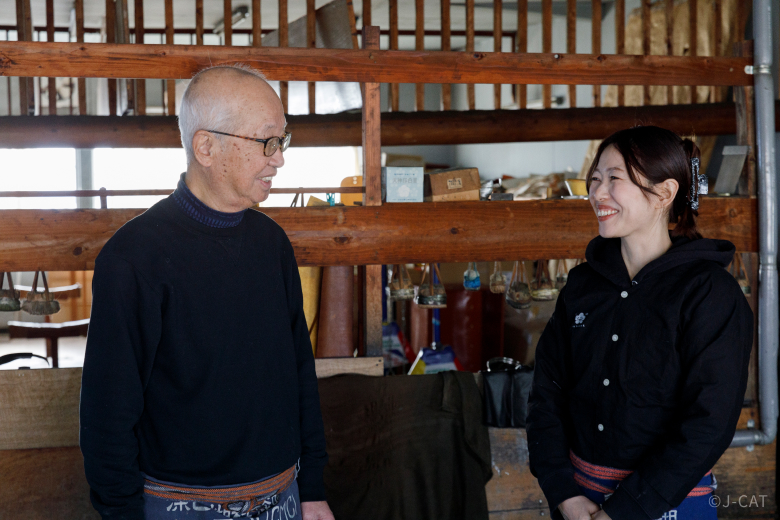
Watching the Ishizukas will remind you of the irreplaceable bonds between family
Although no one can predict the future of Edo komon or Ishizuka Senko, Yukio’s words are convincing: "Even if times change, the quality of Edo komon will remain.” He adds, “What matters is to what extent we can continue doing this work that has been passed down for generations. I look forward to my daughter's future efforts.” Kumiko also says, “Right now, there are still some tasks that are difficult for me. My goal for the near future is to be able to accomplish these tasks just like my father has done.”
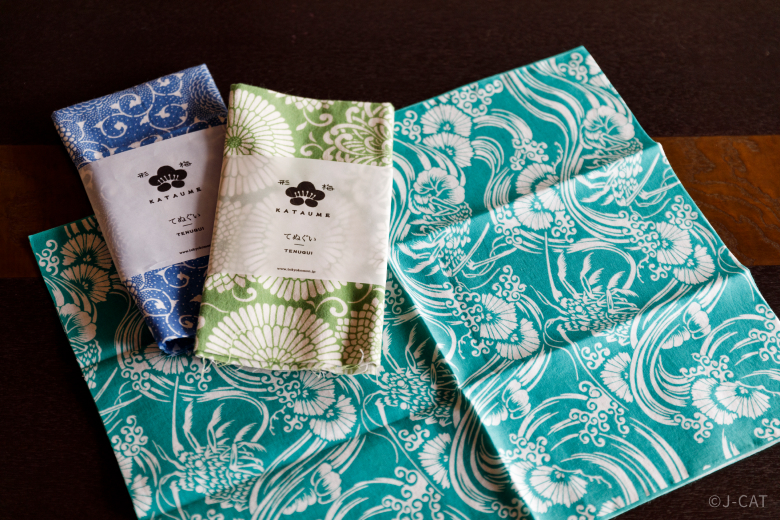
As part of Wabunka’s Edo komon experience, you can choose the color and pattern of your own tenugui hand towel under the Ishizukas’ guidance
Wabunka offers an Edo komon experience in which you will tour Ishizuka Senko’s historic workshop and add a beautiful pattern called shironuki (whiteout) to your own tenugui hand towel using special stencils for Edo komon dyeing. “We want to carefully convey all there is to know about Edo komon, so this experience is limited to a small number of participants per session," says Kumiko. Join the Ishizukas’ uniquely local dyeing experience to feel the spirit of Edo chic and witness the bond between these two artisans who balance tradition and innovation.
Conveying Hachioji, the Town of Dyeing and Weaving, to the World
Once known as Japan’s mulberry capital, Hachioji thrived in sericulture and textiles. From the Meiji era (1868-1912) to the post-war period, it continued to uphold its heritage as a town of dyeing and weaving by developing new products in line with technological innovations and changing lifestyles. Today, although Hachioji has seen a decrease in the number of local textile factories, it is still a town where artisans who preserve traditional techniques gather.
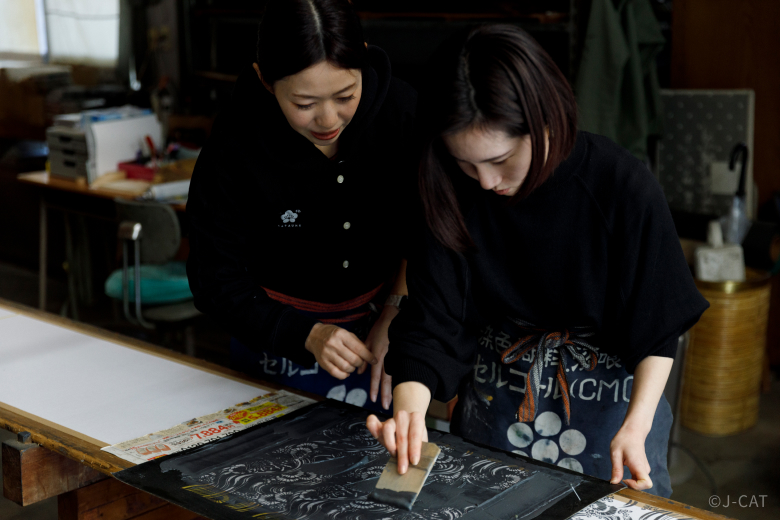
Making a tenugui hand towel as part of a Wabunka experience
Ishizuka Senko helps promote Hachioji’s cultural traditions as it continues working with local dyeing and weaving studios. In addition to hosting studio tours and dyeing experiences, it also collaborates with Hachioji-based contemporary artists and textile workshops. Together, they strive to develop original creations born in Hachioji that weave tradition into modern sensibilities.
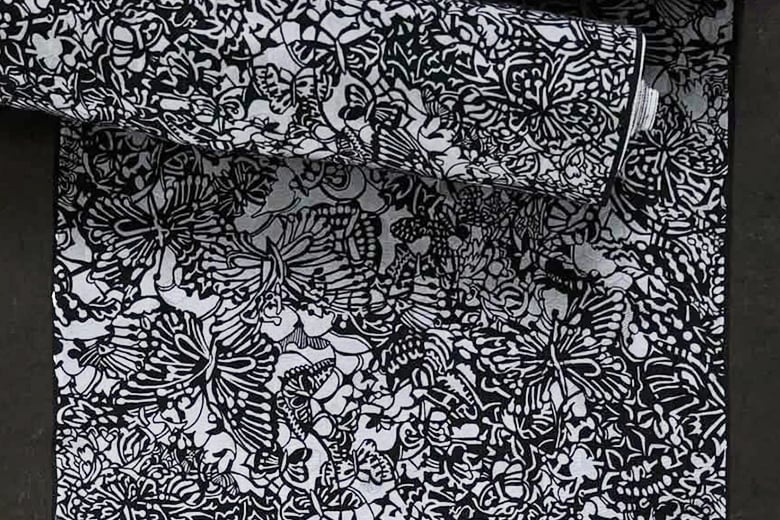
Designed in collaboration with Hachioji-born artist Mayako Nakamura, this Edo komon kimono combines traditional techniques and contemporary art
Easily accessible from Shinjuku by train in about 40 to 50 minutes, Hachioji is abundant in nature. Mt. Takao is located here, and the beautiful scenery changes with the seasons. In addition, events such as the summertime Hachioji Festival offer opportunities to experience the local culture and warm hospitality. Come to Hachioji to witness and experience for yourself its nature, heritage of dyeing and weaving, and other cultural traditions.
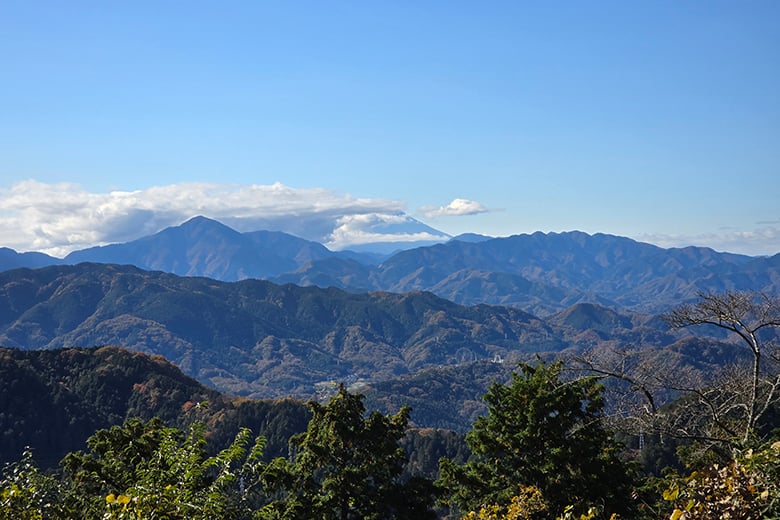
Mt. Takao is a prominent part of Hachioji’s rich natural landscape
Ishizuka Senko
Located in Hachioji, Tokyo, Ishizuka Senko is a dyeing studio with over 130 years of history. Specializing in Edo komon dyeing techniques that have been passed down for generations, the studio is headed by fourth-generation artisan Yukio Ishizuka, who was bestowed the title of Master of Traditional Crafts by the Ministry of Economy, Trade and Industry (METI), as well as the title of Tokyo Meister. His daughter, Kumiko Ishizuka, will succeed him as the fifth-generation head. While preserving long-standing traditions, the Ishizukas have launched an original brand that suits modern sensibilities and explores new possibilities for Edo komon.


