
Living in harmony with nature, Hara's origins and his encounter with Hida
Hara's love of mountains began in childhood, when he walked the Kuju mountain range of his native Oita, Kyushu with his father. After moving to Tokyo for university, he worked long hours and late nights as a systems engineer. On weekends, he frequently hiked the Yatsugatake and Yari-Hotaka mountain ranges and volunteered to host nature observation events in the rural areas around Tokyo. Through these experiences, he discovered the joy of sharing his love of nature and mountains with others.

Hida is enveloped by notable mountains – Norikura to the east, Haku to the west, Yari and Hotaka to the north, and Ontake to the south
Hara has been a Hida resident since 1995, when he was first drawn to the Takayama Basin’s panoramic mountain views of Haku, Norikura, and Ontake, and to the deep spiritual culture. While working with educational NPO’s centered on the natural environment in Hida and Nagano, he obtained guide certification just two years after the Japan Mountain Guide Association established the qualification. Today he serves as chairman of the Hida Association of Mountain Guides in addition to his continued work as a mountaineering guide and writer.
A Walk in the Mountains Reveals the Ties Binding Nature and Culture
Mountain climbers are far from the only ones moving about in Hida’s mountains. Here dwell plants and animals that have reached the present day by surviving an ice age, harsh volcanic landscapes. They are also home to an ancient, long-standing culture and way of life.

An active volcano, Mount Norikura straddles Gifu and Nagano Prefectures
The Japanese rock ptarmigan (Lagopus muta japonica) is one such local resident. Listed by the government as a special natural wonder, these are fascinating birds that reached Japan from the Eurasian mainland during the latter part of the last glacial period and have miraculously continued to survive here for some twenty thousand years since.
They typically form monogamous pairs, with mothers incubating a clutch of six to seven eggs for 21 days. Shortly after hatching, the chicks acquire vital gut bacteria that will allow them to not only survive but flourish – detoxifying, digesting, and absorbing the nutrients of the alpine flora – by eating their mother’s partially digested cecal pellets, produced by a pair of 30-centimeter cecal pouches within her only about 37-centimeter body. This adaptation is just one of the ways life finds a way in this extreme environment.
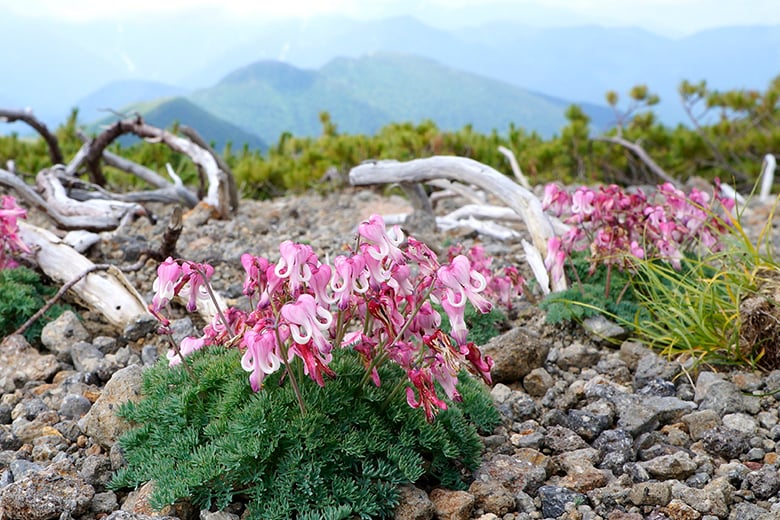
Komakusa (Dicentra peregrina), affectionately known as “Queen of the Alps” – hardy alpine plant, butterfly, and bird species flourish here
In the 1980s, there were an estimated 3,000 Japanese rock ptarmigans in the region, though that number has since been halved due to threats such as climate change, new alpine predators like foxes and martens, and human activity. But thanks to a joint conservation and propagation project by the Environment Ministry and a team from Shinshu University, this trend is being beaten back. Today a fledgling 150-bird population dwells in the Central Alps, where they had completely disappeared.
“The ptarmigan is a barometer for the whole ecosystem, and a touchstone for the spiritual culture here,” says Hara. “To understand its relationship with the Japanese people is to understand that spirituality toward nature in living color.”
The Mountain as a Place of Prayer and Devotion
Mountain worship in Hida continues to this day. People in the region have long revered the mountains as deities, and as worlds to which the souls of departed ancestors return. Shrines in the foothills and miniature prayer altars on the summits of the inner peaks stand as testaments to the holiness of these places.
All over the region, seasonal festivals are held honoring them and seeking their blessings, such as in spring to pray for bountiful crops, in summer to ward off disease, and in autumn to give thanks for the harvest. Such practices can still be seen today – such as in the shishimai lion dances that roam residential neighborhoods accompanied by drums and flutes.

A panorama from ascent of Mount Norikura
Norikura and Ontake are two of these venerated sacred mountains. As Hara tells it, Edo period (1603-1868) villagers would hike them at night in prayer for rains, resulting in over a dozen different pilgrimage routes up Norikura alone. Contemporary records from a local government office tell of a sacred prayer site near the ridge, where a monk carved Buddhist figures and submerged it beneath pond waters to appease a wrathful god. Implements of prayer ritual, such as dosho bronze gongs and taiko drums are still passed down to the villagers living at the foot of the mountains today.
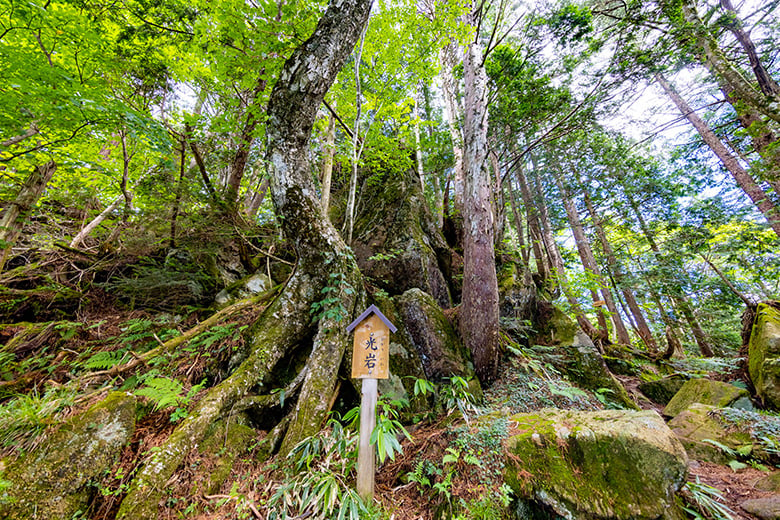
Mount Kurai is an ancient and long-revered power spot
Alongside these customs developed the syncretic religion of Shugendo, in which practitioners trained themselves through ritual austerities deep in the sacred mountains, seeking supernatural powers to perform miracles and save villagers from suffering and hardship. “The power of the mountain as a place of prayer is also a warning against human arrogance,” explains Hara, who adds that the footprints of the Shugendo practitioners who first installed the prayer altars are still visible, giving visitors who walk these mountains today a chance to feel this history of spirituality in harmony with nature firsthand.
Prayers in the Trees: Hida’s Spiritual Culture in Enku’s Statues
The early Edo period monk Enku, who traveled Japan performing just this sort of ritual mountain asceticism, is said to have carved some 120,000 wooden Buddha figures during his life. Of these, some 600 still remain in Hida, treasured and protected by the local people to this day.
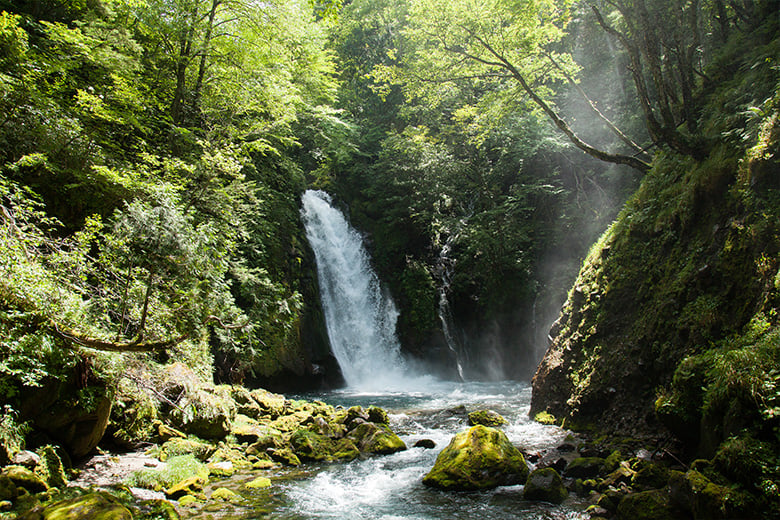
The woods of Goshikigahara unfurl at the foot of Norikura, and may only be entered with a guide
Enku bestowed Buddhist figures upon villagers as personal guardian spirits protecting homes and fields and comforting them in hard times. Enku continues to inspire people today as a pillar of faith with legendary status, whose story has been passed down through the generations. Because Enku spent many days in Hida in his later years, countless stories of him live on in the local temples, shrines and villages, and he has become a core figure in local folk faith.

Enku is known for seeking salvation for others through Buddhist sculpture, and his faith and spirit live on in Hida
Hara says the appeal of Enku Buddhas lies in their unique artistry and deep spiritual faith. In his analysis, Enku Buddhas likely stood as icons of healing and hope for people seeking spiritual support in the feudal society of the period. Hara also expresses great personal respect for Enku's sincere approach to life as a Buddhist, and his grasping for the eternal nature of heaven and earth, “born from the root and returning to the root.”
A pilgrimage to view the Enku Buddhas scattered throughout Hida is an opportunity to discover a landscape of prayer rooted in mountain worship, full of inspiration that is still just as powerful and relevant in the modern day.
Discovering the Cores of Hida’s Blessings through Hara
The diverse cultural traditions of Hida have blossomed under the unique combination of its harsh environment, rich nature, and ingenious inhabitants. To truly understand the essence of the region, says Hara, a person has to come into contact with all three.

The changing seasons only further reveal the charm of Hida’s natural world
With the guidance of a local, you can experience the craft of mountain villages and the colors of the seasons one by one – adding irreplaceable and inspiring quality to your travels in Japan, and helping to immerse you in the country’s distinctive uniqueness. Hara hopes to expand the range of his activities beyond Hida to Nagano and Toyama, covering the entirety of what he refers to as the Hida Mountains Traverse Route, so that visitors domestic and international alike can experience the blessings of Japan's nature and culture.

Overlooking the historic city of Hida Takayama
Mountains are liberating, fostering a calm objectivity and new ways of thinking. Hara seeks to draw upon this to weave a warm mutual respect through ancient Japanese wisdom and lifeways in harmony with the delicate seasons and the sometimes harsh power of nature and its disasters.

Hironobu Hara, Chairman of the Hida Mountain Guide Association
The Hida Mountain Guide Association was established in April 1999 to provide mountaineering guide services in the mountain ranges of Hida, while also raising awareness of natural conservation, and promoting safe mountaineering to prevent accidents. Its chairman Hironobu Hara has worked in educational NPOs focused on the natural environment in Gifu and Nagano prefectures, as well as participating in gorge climbing, winter climbing, and observation events in rural areas. He has served as chairman since 2010, and today continues his work as a certified mountain guide and instructor.


