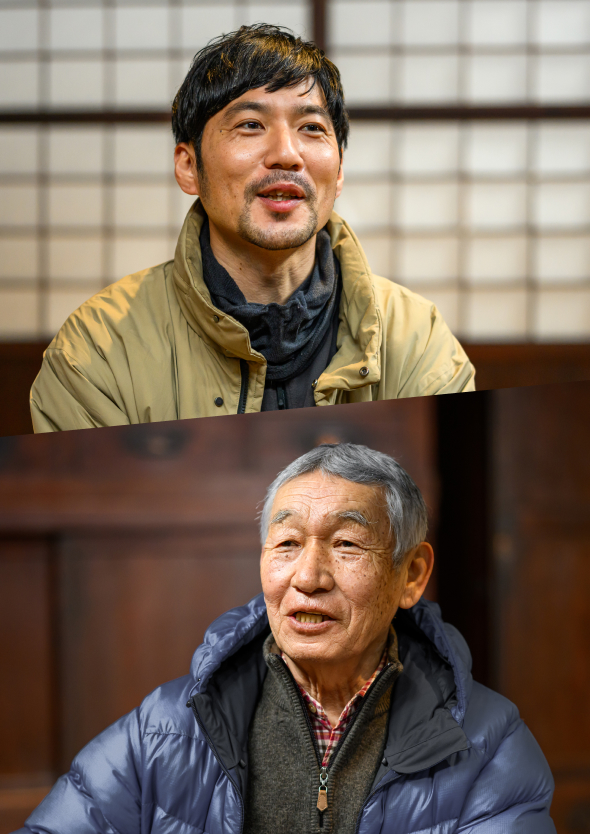
Handicrafts Born of the Woods
– First of all, can you tell us a little bit about your work?
Adano: I am a lacquer artist working in the Hida-shunkei tradition, as was my father. Simply put, a lacquer artist’s job is to coat wood with lacquer – but what makes Hida-shunkei special is its utilization of lacquer’s translucence to spotlight the natural beauty of wood grain. For a time, lacquer produced in China was commonly used, but recently there has been more momentum behind the use of domestically produced lacquer instead.
I’ve been involved in this myself, founding the Hida Urushi no Mori Project to revitalize our area’s lacquer tree forests, and have been planting trees here myself since 2022. We have already planted about 2,000 trees, and aim to plant another 600 trees a year for the next ten years. It takes about 15 years after planting for a lacquer tree to be mature enough to harvest. We want to create a forest with a sustained growth cycle.
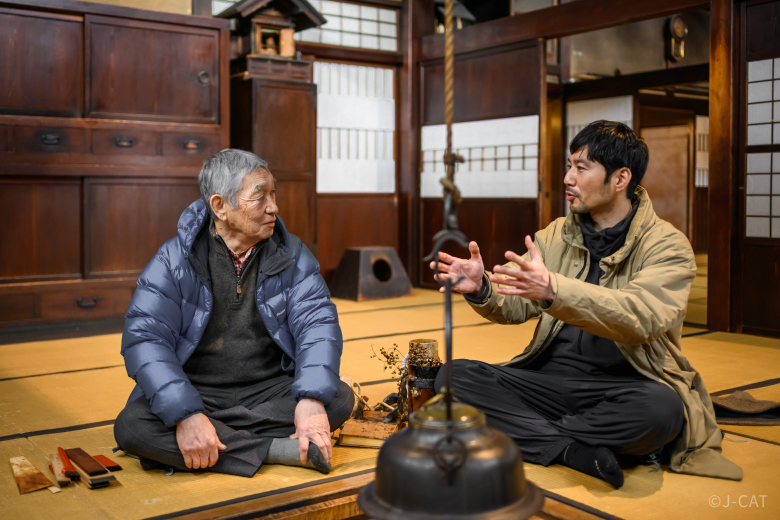
Lacquer artist Kazuo Adano (left) and thatcher/charcoal burner Takuma Fujiwara (right)
Fujiwara: I work mainly as a thatcher, and deal with buildings registered as cultural assets, such as shrines, temples, old folk houses, and the ruins of ancient dwellings. I’ve also recently been trying to develop new applications for traditional techniques, such as thatching a nursery school’s treehouse and incorporating thatch into modern architecture.
In the winter, I work as a coal burner, felling mountain trees and using them to produce charcoal – which helps to maintain the health of the forest. When people ask me what I do for a living, I sometimes don’t know how to answer in a word, but everything I do is based in the idea of making use of the mountain’s natural resources.
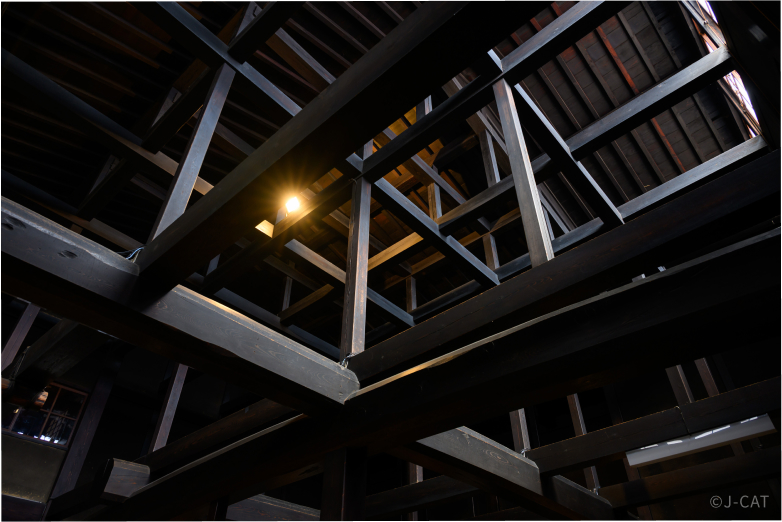
The structure of the Kusakabe Folk Crafts Museum preserves the architectural style of the Edo period and showcases the skills of the artisans of Hida
The Unique Resources and Techniques of Hida-Takayama
– What distinguishes the thatched roofs of Hida Takayama, and Hida-shunkei lacquerware, from similar crafts in other regions?
Fujiwara: Thatching is a general term, and the materials and methods used to make thatched roofs vary with the region. The Hida region gets a lot of snow, so local varieties of silvergrass like kariyasu or suzuki as well as bamboo grass like kumazasa are commonly used here. Hida is also known for a roofing style called kurebuki, using thin wood boards weighted in place using stones. The Gassho-style roof is the prototypical example, making use of a variety of local wood and other plants. In fact, thatching wasn’t invented by artisans at all, but rather by farmers who would venture into the mountains in collective groups to harvest grass and repair their roofs.
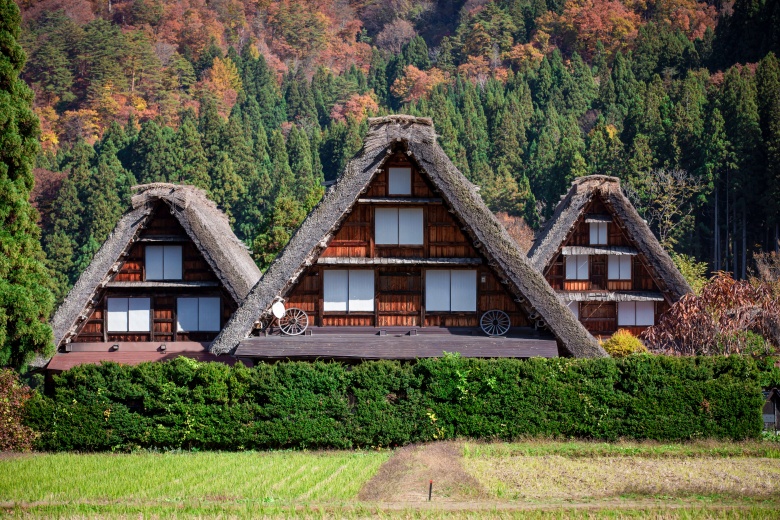
The Shirakawa-go World Heritage site, where featuring over a hundred Gassho-style thatched-roof houses
Adano: Hida-shunkei lacquerware is the product of a woodturner, who forms the shape of the piece, and a lacquerer who applies many coats to bring out the wood grain. In other areas, lacquer tends to be mass blended to a given standard and sold after this processing, whereas here in Takayama it is the lacquer artists themselves who process it to their own unique specifications from the raw material. This gives Hida Shunkei pieces a stronger sense of individuality.
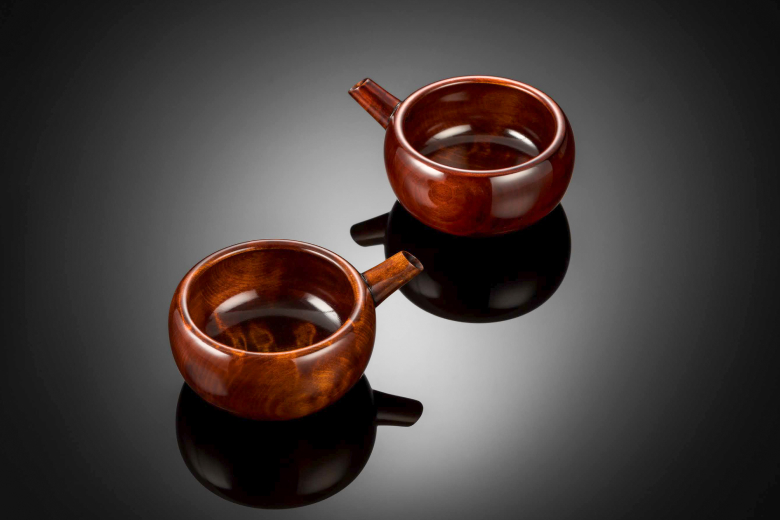
Works by Adano, where the translucent lacquer coating spotlights the beautiful wood grain
Lacquer can be pigmented in a variety of ways, such as by adding iron to make it black. The addition of soil also gives it the properties of putty. This flexibility of application, achieved entirely with natural materials, makes it a very compelling substance to work with.
Two who Conserve a Material Heritage for the Future
– What kinds of hurdles do you face with regards to forest resources, and what measures are you taking?
Fujiwara: The forest is in a state of decline. Satoyama and its woodlands are the root of all that we do, and without proper care it will not thrive – nor will we.
Adano: Exactly. I started the Urushi Forest Project for that reason, to help revive Hida’s local supply of lacquer. We currently have about 2,000 seedlings growing, but we have to thin out their surroundings constantly to prevent the fast-growing broadleaf trees like walnut from outgrowing them. The woodturners help us with this, but the area we can cover is limited by our numbers. That’s why we especially want young people to join us.
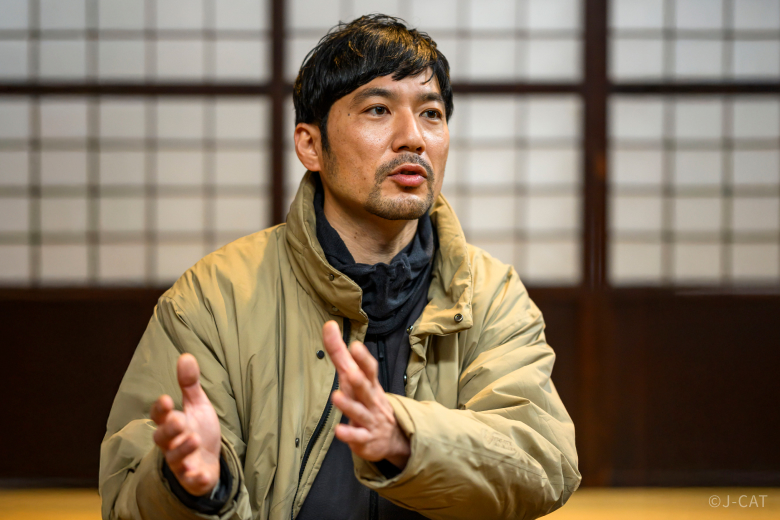
Fujiwara speaking passionately on the future of forest conservation
Fujiwara: Thinning out the surrounding foliage can feel like a chore, so we like to make it more of an event. And in fact, a lot of human work to preserve the health of the forest in days past was done just as child’s play: picking wild plants, cutting down bamboo to build forts. When I was a kid, my grandfather taught me how to identify medicinal herbs, but that kind of knowledge is fading away today. Ideally, we’d make something fun of all of this.
Adano: Children playing in these woodlands is good for the children and the woodlands both. Things like making a dandelion stem flute and nibbling on wildflowers brings the children closer to nature and helps keep the forest thriving – which help to keep the crafts of lacquerware and crafts thriving too.
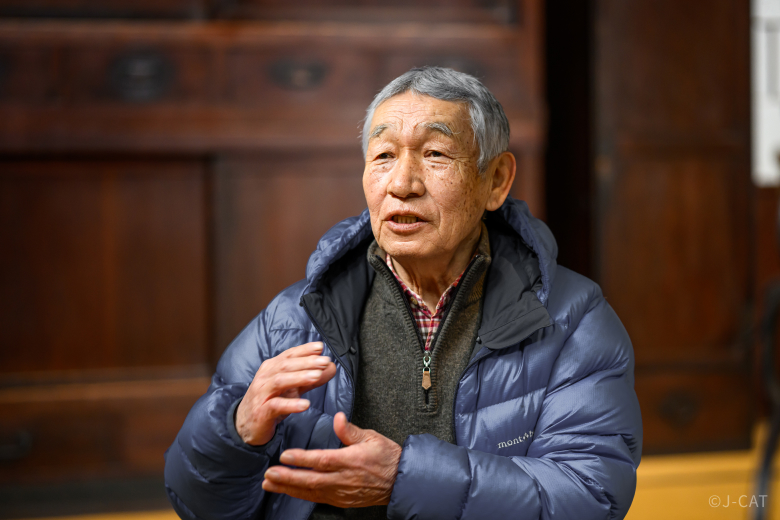
Adano strongly believes in the vitality of revitalizing lacquerware culture, and passing it down to new generations
Fujiwara: Medicinal herbs and mushrooms grow everywhere in Satoyama, and there are still many you can just pick and eat. But people today can’t identify them. My grandfather taught me which were edible and which were dangerous, and I had a lot of fun as a child learning about nature. I think a systematic approach that puts people back in touch with the fun of being in the woods – rather than a bunch of stiff talk about “traditions” and “craft” – is vital, and will lead people to experiencing and appreciating the depth of the techniques and heritage we are trying to preserve.
Two Loving Guardians of the Forest are your Guides through Hida-Takayama
– Last, what do you think is the appeal of Hida-Takayama for tourists?
Fujiwara: So much of what we rely on in our lives comes from Hida’s natural environment. The Satoyama area is not just beautiful; it’s also a window into the foundations of Hida’s characteristic food, clothing, construction, and history. Japan was once a place where people lived in harmony with nature, and if you’re searching for the wisdom of those times, Satoyama is the place to find it. The landscape that lives on here is one that used to be all over the country, but is rapidly disappearing. Hida is a place where you can feel the very origins of Japan.
Kokufu, Nyukawa, Asahi, Hiwada, Kawai – these areas of Satoyama retain scenery unchanged for hundreds of years. It’s accessible in less than an hour from Takayama Station, and perfect for touring on bicycle.
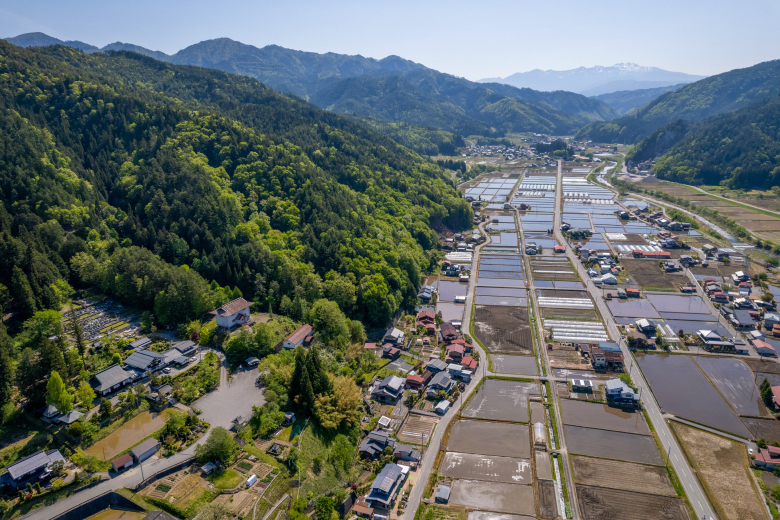
The peaceful rural townscape of Kokufu
Atano: The old townscape is vibrant and atmospheric during the day, but even lovelier in the evening as the quiet settles. You can take in the feel of the place as it was in the old days.
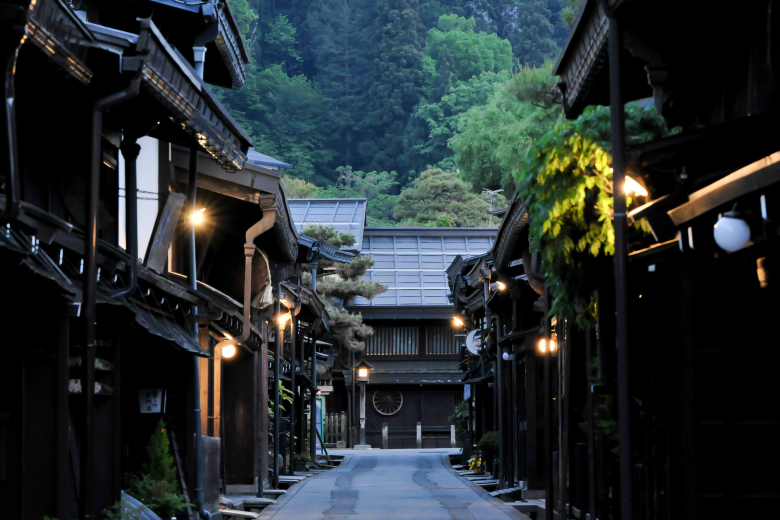
Evenings in the historic townscape are uncrowded with tourist traffic
Takayama’s Miya river is also undergoing a natural return to its pristine natural state. Feeling of the natural water cycle that links the mountains and rivers to the sea is part of the charm of the Hida countryside. Lacquer and thatch both depend on the health of this ecosystem. I hope people can experience the town and the Satoyama countryside with a mind to harmony between human life and the forest.
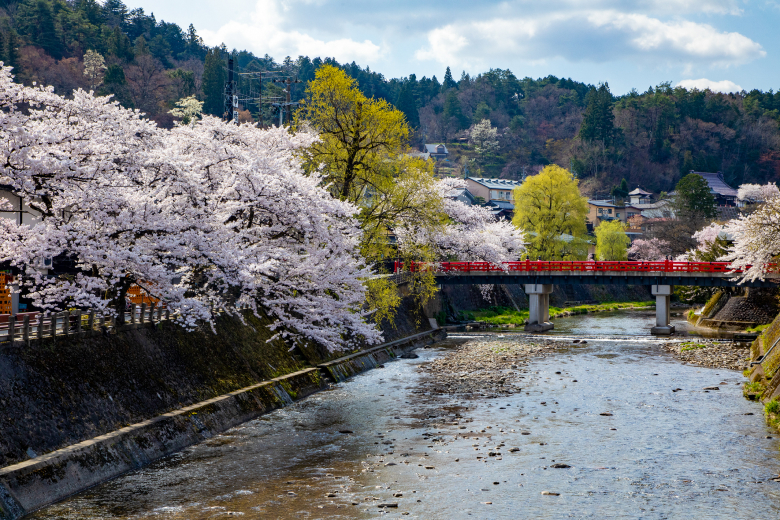
The Miya River, which flows through the center of Takayama
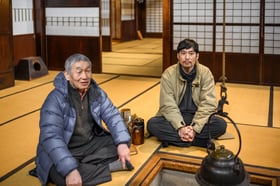
Kazuo Adano / Takuma Fujiwara
Kazuo Adano, Hida-shunkei Lacquerware Artist (left)
One of the few remaining practitioners of the legacy Hida-shunkei lacquer craft. He also heads the Hida Urushi no Mori Project, which works to revitalize the lacquer tree forests of Hida and protect local lacquer production. He is passionate about safeguarding this heritage craft.
Takuma Fujiwara, Thatcher and Charcoal Burner (right)
A craftsman seeking to communicate the harmony with nature that has undergirded Hida’s culture and lifestyle since the prehistoric Jomon period to the present day. In addition to performing roof thatchwork for Hida’s historic Gassho-style houses and Jomon pit dwellings, he also works on modern installations utilizing these historic techniques, such as for shops and private residences. In the winter, he also works as a charcoal burner.
Kusakabe Folk Crafts Museum (interview support)
Located in a historic townhouse listed as an Important Cultural Property Gifu Prefecture’s Hida-Takayama, the Kusakabe Folk Crafts Museum showcases the culture and history of the town. It was opened in 1966 under the aegis of the prosperous Kusakabe merchant family. In 2023, its century-old detached annex was renovated as Taniya, an inn accepting only one group per day.